




Vancouver, British Columbia–(Newsfile Corp. – August 25, 2026) – J2 Metals Inc. (TSXV: JTWO) (OTCQB: JTWOF) (FSE: OO10) (“J2” or the “Company“) is pleased to provide an update on exploration at its Sierra Plata silver-gold-antimony project (“Sierra Plata” or the “Project“), located in the Taxco district of Guerrero State, Mexico. Since field work began in late May 2026, the Company’s crews have completed systematic geological mapping, prospecting and rock sampling across approximately half of the Project area, identifying seven veins, locating 20 historical mine workings, and returning multiple high-grade silver assays that will guide a first-ever trenching program.
Highlights
-
Best results from the 186 mapping rock samples collected to date include 1,030 g/t Ag (dump sample, El Sabino), 941 g/t Ag over 0.7 m with 1.9% Pb and 4.3% Zn (channel sample on the El Sabino vein trend), 811 g/t Ag over 1.4 m (channel, El Sabino) and 788 g/t Ag with 1.05 g/t Au (channel, El Salto).
-
Seven veins identified to date, including the San Miguel vein; sampling has highlighted the El Salto and El Sabino veins as new priority areas for follow-up.
-
Approximately 50% of the Sierra Plata project area now mapped for geology, alteration and structure; silver mineralization is preferentially developed where veins are hosted in tuff and limestone.
-
20 historical mine workings located to date, including the El Sabino mine with more than 30 m of underground development on two levels.
-
Trenching program being designed across the El Sabino, San Miguel, El Salto and El Resumidero veins, with trenches planned every 25 to 30 metres along strike; drill permitting is advancing in parallel.
-
Drill permitting is in process to be able to test key targets in a maiden diamond drill program.
“The first two months of systematic work at Sierra Plata have exceeded our expectations,” said Thomas Lamb, CEO of J2. “We are seeing high silver grades not only at the historical mines that first attracted us to the district, but also on newly recognized structures such as the El Salto and El Sabino veins. With half the property still to be mapped, seven veins already defined and 20 historical workings located, we are moving quickly to trench top targets and to secure the permit for a first drill program. The work carried out to date by our technical team led by Carlos Cham in Mexico has been excellent and we are very excited by the results and discoveries being made.”
Rock Sampling Program
A total of 186 rock samples (channel, chip, dump and float samples) have been collected from veins, mineralized structures and historical workings across the Project, with assay results received for all samples. Selected best results are summarized in Table 1.
Table 1: Selected best silver results from mapping activities to date
| Sample | Type | Width (m) | Ag (g/t) | Au (g/t) | Sb (%) | Old working / structure |
| 798548 | Dump | — | 1,030 | 0.15 | 0.27 | El Sabino mine area |
| 798670 | Channel | 0.7 | 941 | 0.04 | 0.03 | Outcrop along the El Sabino vein trend |
| 798514 | Channel | 1.4 | 811 | 0.14 | 0.05 | El Sabino mine |
| 798563 | Channel | 0.25 | 788 | 1.05 | 0.02 | El Salto mine |
| 798564 | Channel | 0.15 | 643 | 1.13 | 0.02 | El Salto mine (second-level heading) |
| 798594 | Channel | 0.7 | 583 | 0.10 | 0.06 | El Resumidero |
| 798695 | Chip | 0.8 | 427 | 0.08 | 0.12 | Cedro Rojo prospect |
| 798568 | Channel | 0.1 | 296 | 3.34 | 0.02 | El Salto mine |
Channel and chip sample widths are as recorded in the field and may not represent true widths. Dump and float samples are selective by nature; all reported samples are selective in nature and are not necessarily representative of the mineralization hosted on the Project.
In addition to silver, several of the best samples carry significant base-metal and antimony values, including 4.3% zinc and 1.9% lead in sample 798670, 2.1% zinc in sample 798548 (with 0.27% antimony), and gold values of up to 3.34 g/t (sample 798568, El Salto).
Geological Mapping
Slightly more than 50% of the Project area has now been mapped, outlining four principal rock types: limestone, black shale, andesitic tuff and a polymictic conglomerate. Mapping to date has suggested that veins return better silver assays where hosted in tuff or limestone, while mineralization is less well developed within the black shale. Alteration is dominantly argillic, with silicification developed near structures and lesser advanced argillic alteration also observed.
Veins and Historical Workings
Seven veins have been identified to date: San Miguel, El Trébol, El Salto, El Sabino, El Sabino Sur, El Resumidero and the El Sabino Sur splay. Of these, the San Miguel, El Sabino, El Salto and El Resumidero veins have returned the best results to date; additional sampling of the remaining veins is planned along different segments of their strike length. The Company has also located 20 historical mine workings or prospect pits/adits on the Project, including the El Sabino mine (more than 30 m of development on two levels), the El Salto mine (15 m of development plus a shaft), the San Miguel and La Noria mines, and numerous prospect pits and shafts. These old workings provide direct access to the mineralized structures for sampling and confirm the extent of historical mining activity across the district.
A map of the current geology, vein traces and historic workings is presented below in Figure 1.
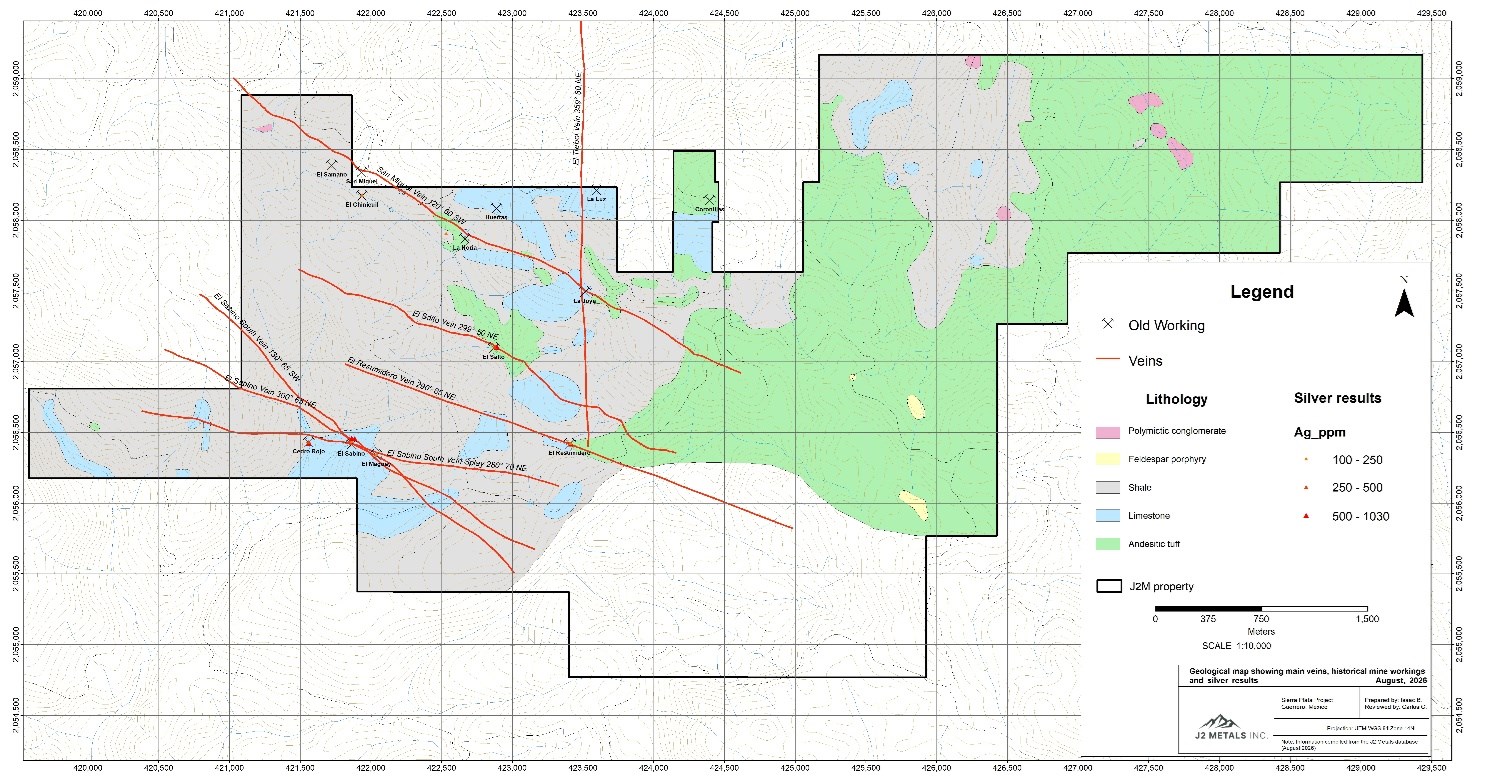
Figure 1. Sierra Plata Detail Mapped Geology and Historic Workings
To view an enhanced version of this graphic, please visit:
https://images.newsfilecorp.com/files/11550/311369_e71aabab8419abb4_002full.jpg
Next Steps: Trenching and Drill Permitting
With initial sampling results in hand, the Company’s priority is a first trenching campaign focused on the El Sabino, San Miguel, El Salto and El Resumidero veins, while mapping and rock sampling continue across the remainder of the Project. Trenches are planned at 25 to 30 metre intervals along strike, depending on terrain, with locations guided by three-dimensional projections of the known veins generated in Leapfrog software from the structural measurements collected on each vein.
In parallel, the Company is advancing the drill permit application for the Project. The supporting documentation has been assembled, and the required government report is in preparation, while community engagement regarding drill-site access is ongoing. Potential drill locations are being defined based on rock sampling results and preliminary data from the drone magnetic survey, which is approximately 50% complete.
Qualified Person
The technical content of this news release has been reviewed and approved by Graham Giles, P.Geo., a Technical Advisor to J2, who is a Qualified Person as defined under National Instrument 43-101 – Standards of Disclosure for Mineral Projects.
Sampling Methodology and QA/QC
Samples were submitted to ALS in Zacatecas, Mexico, for preparation and analysis. Samples were prepped using ALS’s PREP-31Y procedure, which involves crushing to 70% passing 2 mm, using a rotary splitter to obtain a 250 g sample, and pulverizing it to 85% passing 75 microns. Gold was analyzed by fire assay with AES finish (Au-ICP21), silver by Ag-OG62, and multi-element geochemistry by ME-ICP61a.
About the Sierra Plata Project
The Sierra Plata Project is a 2,203-hectare silver-gold-antimony exploration project situated within Zacualpan, one of the most important historically productive epithermal mining districts in Mexico and includes five past-producing high-grade mines localized along regionally extensive, structurally controlled vein corridors. Recent sampling of waste dumps at Sierra Plata returned grades of up to 3,932 g/t AgEq. Mineralization is hosted in quartz-dominant vein systems containing fine-grained sulphides with associated gold and antimony, reflecting a low to intermediate epithermal system with strong vertical metal zoning. Alteration assemblages, vein textures, and metal associations observed at surface are consistent with upper-level exposure of the epithermal system, with historic mining largely confined to near-surface levels. The Company anticipates identifying a large number of high-priority targets for drill evaluation.
Grant of Stock Options and Restricted Share Units
The Company also announces the grant of an aggregate of 1,775,000 stock options and 900,000 restricted share units (“RSUs“) to directors, officers, and consultants of the Company, in accordance with the terms of the Company’s new omnibus incentive plan approved by the board of directors on August 22, 2026 (the “Omnibus Plan“). The options are exercisable at a price of C$0.15 per share for a period of five years, and vest as to 1/3 on the date of grant, 1/3 six months from the date of grant, and the remaining 1/3 twelve months from the date of grant. The RSUs vest as to 1/3 on each of the first, second, and third anniversaries of the date of grant. The Omnibus Plan and the grants described herein remain subject to the Company complying with all applicable requirements of the TSX Venture Exchange.
About J2 Metals Inc.
J2 Metals Inc. (TSXV: JTWO) (OTCQB: JTWOF) (FSE: OO10) is a multi-commodity explorer advancing silver, gold, and antimony projects with historical production or significant drill results across established mining jurisdictions in Mexico, Québec, and Alaska. At Sierra Plata in Zacualpan, Mexico, one of the most historically productive epithermal districts in the country, recent waste dump sampling has returned grades of up to 3,932 g/t AgEq across five past-producing silver-gold mines. Active geological mapping and drill permitting are underway. At the Miniac Project in Québec’s Abitibi Greenstone Belt, a newly completed 41-kilometre OreVision™ IP survey has identified prospective chargeability and resistivity anomalies coincident with previously identified EM targets, supporting a planned Phase II drill program of up to 5,000 metres across a largely untested 7-kilometre conductive horizon.
At the Napoleon Project in the Fortymile district of Alaska, a prolific placer camp with up to one million ounces of historical gold production, rock-chip samples have returned up to 596 g/t gold, with historical drilling by Teck and Kennecott reporting intercepts of 8.9 g/t gold over 3 metres and 0.9 g/t gold over 79 metres.
For further information, please contact:
Thomas Lamb
CEO and Director
J2 Metals Inc.
E-Mail: info@j2metals.ca
Neither the TSX-V nor its Regulation Services Provider (as that term is defined in the policies of the TSX-V) accepts responsibility for the adequacy or accuracy of this release.
Forward-Looking Statements
Mineralization hosted on adjacent and/or nearby properties is not necessarily indicative of mineralization hosted on the Company’s property. This news release contains statements that constitute “forward-looking statements.” Such forward-looking statements involve known and unknown risks, uncertainties and other factors that may cause the Company’s actual results, performance or achievements, or developments to differ materially from the anticipated results, performance or achievements expressed or implied by such forward-looking statements. Forward-looking statements are statements that are not historical facts and are generally, but not always, identified by the words “expects,” “plans,” “anticipates,” “believes,” “intends,” “estimates,” “projects,” “potential” and similar expressions, or that events or conditions “will,” “would,” “may,” “could” or “should” occur.
This news release contains forward-looking statements within the meaning of applicable Canadian securities legislation. Forward-looking statements include, but are not limited to, statements regarding the Company’s exploration plans, potential drill targets, anticipated exploration results, the timing and success of future exploration programs, and the grant and vesting of stock options and restricted share units and the receipt of shareholder approval therefor. Forward-looking statements are based on the opinions and estimates of management as of the date such statements are made and are subject to a number of risks and uncertainties that could cause actual results to differ materially from those anticipated. Forward-looking statements are based on a number of material assumptions, including, but not limited to, assumptions that required permits and regulatory approvals will be obtained on anticipated timelines, that the Company will have sufficient financing to fund its planned exploration programs, that exploration and survey results will support continued advancement of the projects, that contractors and personnel will remain available, and that commodity prices and general market and economic conditions will remain consistent with management’s expectations. These risks and uncertainties include, but are not limited to, geological risk, exploration risk, fluctuations in commodity prices, operational risks, regulatory approvals, and general market and economic conditions. Readers are cautioned not to place undue reliance on forward-looking statements. The Company undertakes no obligation to update or revise forward-looking statements, except as required by applicable securities laws.