




Vancouver, British Columbia–(Newsfile Corp. – June 29, 2026) – GREAT ATLANTIC RESOURCES CORP. (TSXV: GR) (the “Company” or “Great Atlantic”) is pleased to provide an update on diamond drilling by HM Exploration Corp. (“HM Exploration”) at Great Atlantic’s Pilley’s Island Project at Pilley’s Island, north-central Newfoundland. HM Exploration holds an option to earn a 100% interest in the project. HM Exploration has provided an update for the sixth to eighth drill holes (PI-26-006 to PI-26-008) completed this year at the project (see HM Exploration news release of June 29th, 2026). The three holes were all drilled within the area of Great Atlantic’s Pilley’s Island Project.
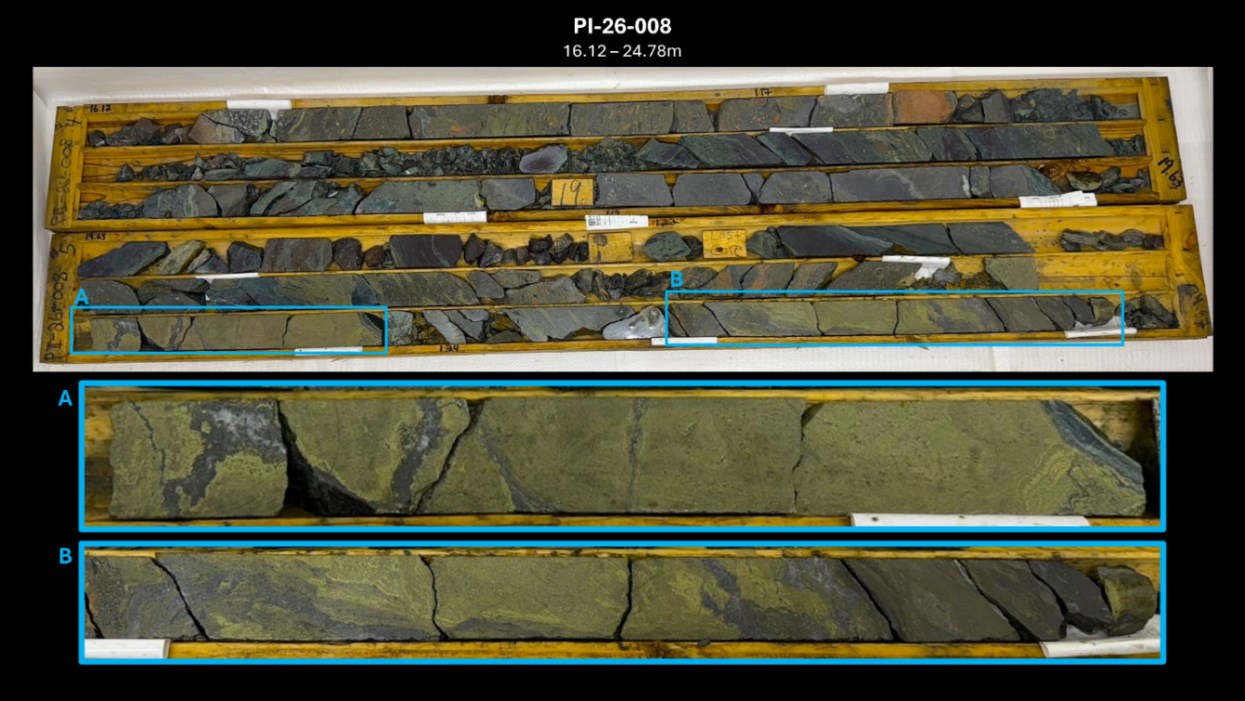
Figure 1 (by HM Exploration): Drill core (upper zone) in hole PI-26-008 from 16.12 – 24.78m downhole. Detailed photo from core box, outlined in blue, highlighting sections of massive chalcopyrite + Pyrite sulphide mineralization. See Table 2 for visual descriptions.
To view an enhanced version of this graphic, please visit:
https://images.newsfilecorp.com/files/3027/303333_6326e2eef4cf7ba9_002full.jpg
“HM Exploration’s reported discovery of a new blind massive sulphide lens represents another positive step in advancing the Pilley’s Island Project,” states Anderson, CEO of Great Atlantic. “This development continues to highlight the property’s potential and reinforces the value of our project portfolio. We look forward to further results of the ongoing drill program and updates as more work continues on the property.”
HM Exploration states that hole nos. PI-26-006 to PI-26-008 represent an additional 544.27 metres for a total drilled meterage of 1,632.27m of a planned minimum 2,500 metres of diamond drilling. HM Exploration refers to their project area as the Lewis Pilley’s Project (the “Project”).
Highlights for holes PI-26-006 to PI-26-008 as stated by HM Exploration include:
- Holes six, seven, and eight have successfully intersected massive sulphide including a new blind discovery of massive sulphide mineralization at a drill core depth of ~155 m. See additional pictures of drill core below.
- Multiple mineralized intervals encountered displaying varying types of mineralization ranging from disseminated – semi-massive – massive sulphide, including:
- PI-26-006
- From 11.43 – 13.62m down-hole; 2.19m drilled length.
- PI-26-007
- From 7.00 – 28.00m down-hole; 21.00m drilled length.
- From 176.85 – 179.00m down-hole; 2.15m drilled length.
- PI-26-008
- From 15.00 – 28.00m down-hole; 13.00m drilled length. (Figure 1)
- From 163.45 – 170.22m down-hole; 6.77m drilled length.
- PI-26-006
- The identification of a second sulphide lens below the previously recognized upper debris-flow horizon supports the interpretation of a vertically extensive VMS system and provides a new exploration target for follow-up drilling.
- Assays pending; HM Exploration looks forward to providing updates as drilling continues.
States Nick Ryan, Chief Geologist for HM Exploration, “While we were expecting to see significant mineralization below the exposed massive sulphide horizon at the Clifford Jones trench, the intersection of the lower-lens came as a welcomed new exciting discovery. The discovery of a second mineralized lens demonstrates that the system is more extensive than previously recognized and supports the potential for multiple stacked sulphide horizons. We look forward to receiving laboratory assays back and delineating the extents of this new discovery with subsequent drilling.”
HM Exploration states the drilling was focused on evaluating the continuity of the mineralized system below known surface showings and along strike of Clifford Jones Zone (the “Zone”) to improve their understanding of the geological controls on mineralization (Figure 2). As stated by HM Exploration visual observations from drilled holes indicate that the upper targeted copper-bearing debris flow was successfully intersected, with zones of alteration and massive to semi-massive sulphide mineralization observed in the drill core.
HM Exploration states that drill holes 7 and 8 have successfully intersected a new lower mineralized sulphide lens that was previously undiscovered. The lower-lens appears more massive indicating that the geometry of this lens may assist with vectoring towards the source vent(s) as depicted in Figure 3. Core samples have been submitted to the laboratory for analysis. Assay results will be released once they have been returned to HM Exploration.
HM Exploration states that all three holes from this release intersected a wide range of massive, semi-massive and disseminated sulphide mineralization over the following drill core lengths*:
- PI-26-006
- From 11.43 – 13.62m down-hole; 2.19m drilled length.
- PI-26-007
- From 7.00 – 28.00m down-hole; 21.00m drilled length. (Figure 4)
- From 155.31 – 155.97m down-hole; 0.66m drilled length. (Figure 5)
- From 176.85 – 179.00m down-hole; 2.15m drilled length. (Figure 5)
- PI-26-008
- From 7.55 – 12.52m down-hole; 4.97m drilled length.
- From 15.00 – 28.00m down-hole; 13.00m drilled length. (Figure 1)
- From 163.45 – 170.22m down-hole; 6.77m drilled length. (Figure 6)
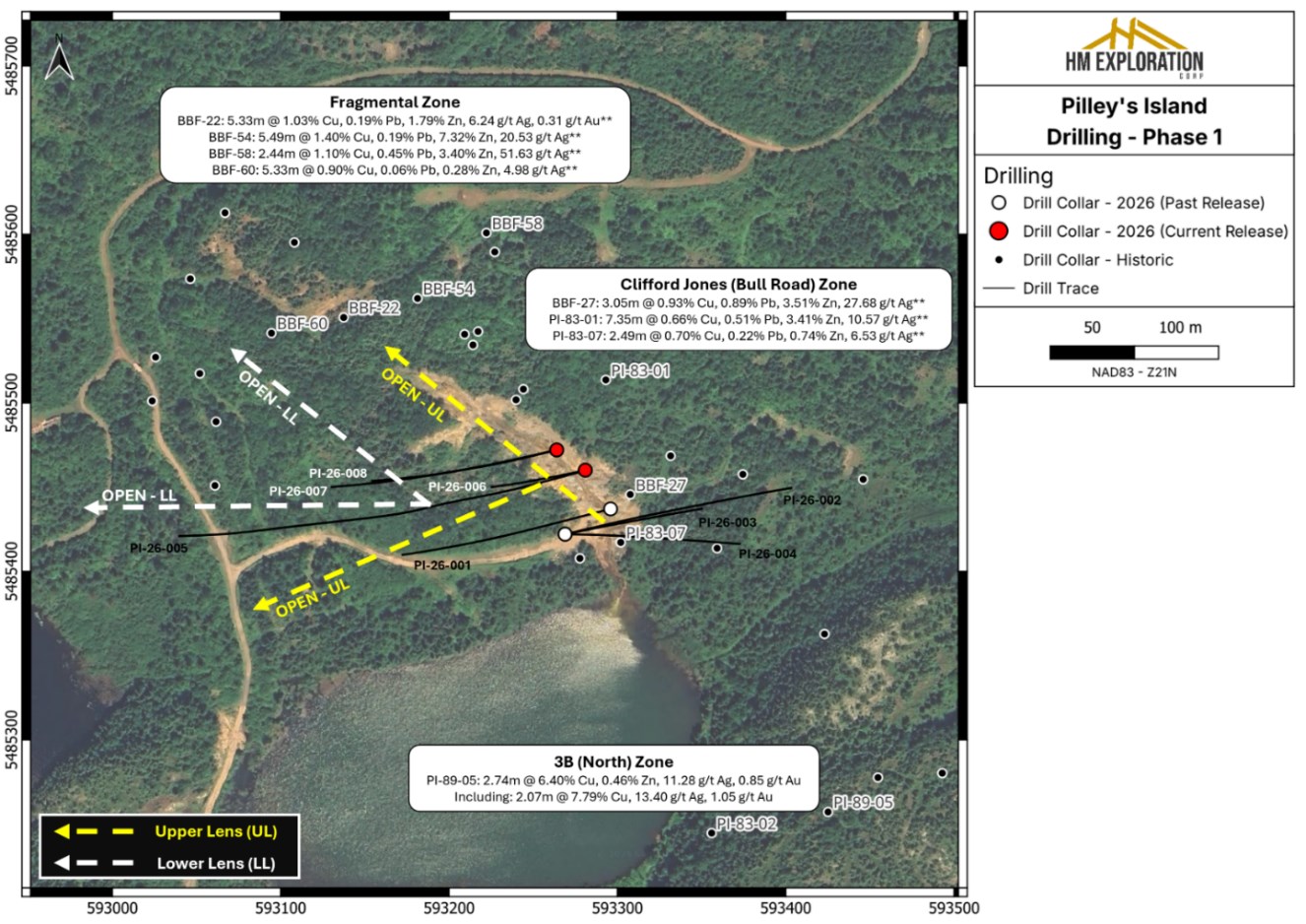
Figure 2 (by HM Exploration): Plan map of 2026 diamond drilling at the Clifford Jones (Bull Road) Zone. ‘This Release’ drill collars shown as red circles; ‘Past Release’ drill collars shown as white circles; Historic drill collars shown as black circles. Currently the upper lens (UL) and lower lens (LL) mineralization remains open along strike and at depth.
To view an enhanced version of this graphic, please visit:
https://images.newsfilecorp.com/files/3027/303333_6326e2eef4cf7ba9_003full.jpg
HM Exploration states that mineralization can be described as clast-dominated debris zones consisting of sub-angular to angular fragments of massive sulphide (~85% of intercept) composed of Cpy + Py ± Sph ± Gn suspended in interstitial fine-grained disseminated sulphides (Py + Cpy ± Sph ± Gn) and milled felsic ± mafic rock. Matrix-dominated debris flow composed of fragments of sub-rounded to angular clasts of massive sulphide (Py + Cpy ± Sph ± Gn) and felsic ± mafic lithic fragments suspended in a matrix of fine-grained sulphide (Py + Cpy ± Sph ± Gn) and milled felsic ± mafic rock. More detailed classifications for individual intercepts are referenced in Table 2 below*.
* The Company cautions that the presence of visible sulphides and visual estimates of mineral abundance are not indicative of grade and should not be considered a substitute for laboratory analysis. Assay results are pending.
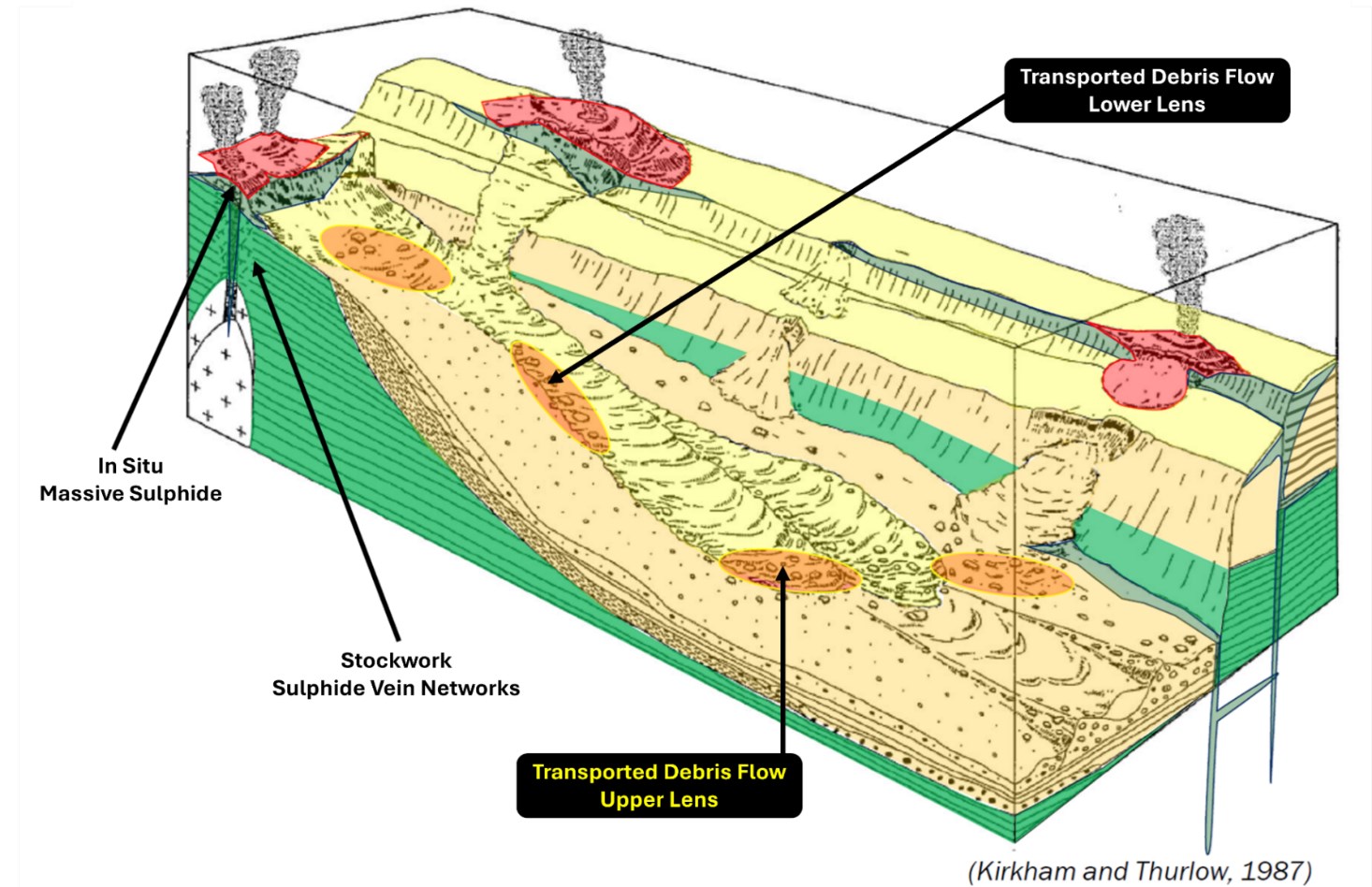
Figure 3 (by HM Exploration): Conceptual VMS model illustrating the interpreted position of the newly identified lower lens relative to the upper debris flow mineralization. Mineralization intersected at the Clifford Jones Zone appears to be transported from source; however, the angularity of the massive-sulphide clasts may indicate limited transport distance from the source vent(s) (Modified after Kirkham and Thurlow, 1987).
To view an enhanced version of this graphic, please visit:
https://images.newsfilecorp.com/files/3027/303333_6326e2eef4cf7ba9_004full.jpg
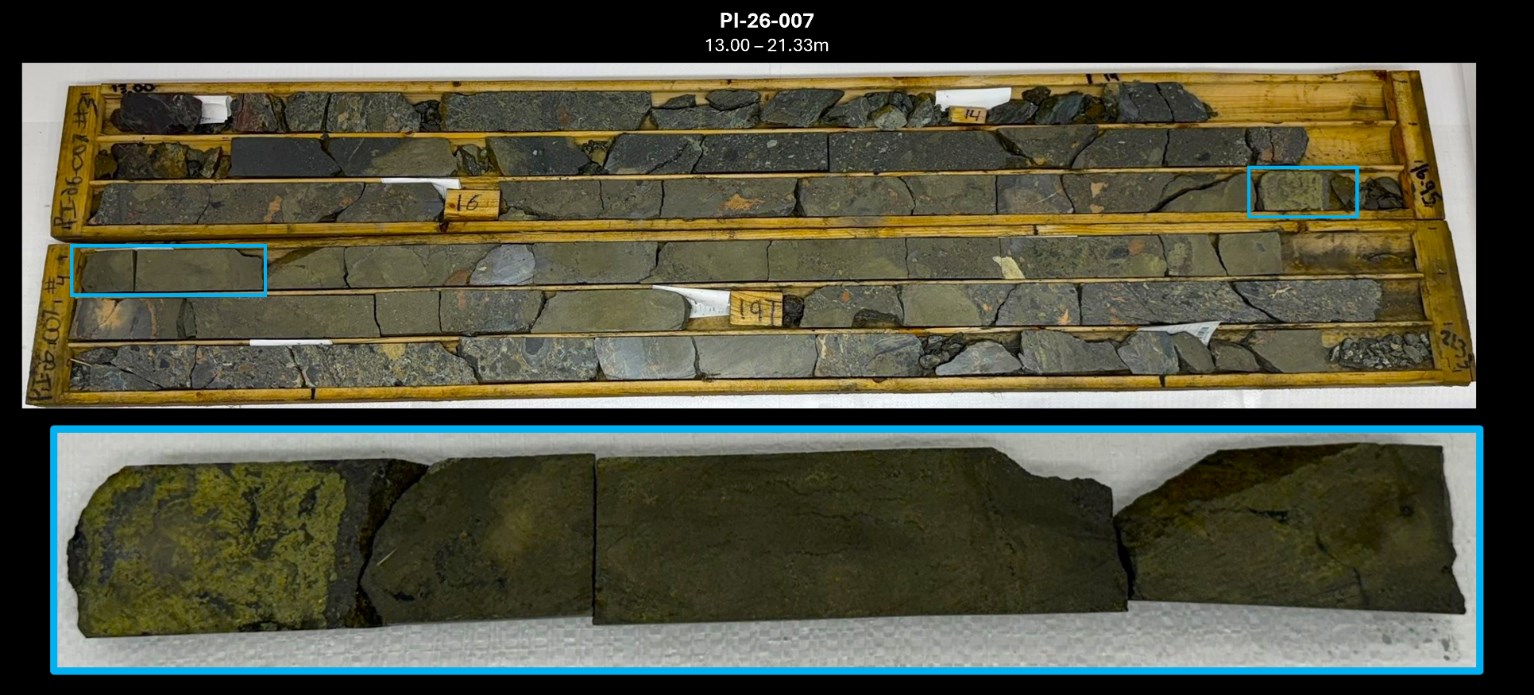
Figure 4 (by HM Exploration): Drill core (upper zone) in hole PI-26-007 from 13.00 – 21.33m downhole. Detailed photo from core box, outlined in blue, highlighting sections of massive sulphide mineralization. See Table 2 for visual descriptions.
To view an enhanced version of this graphic, please visit:
https://images.newsfilecorp.com/files/3027/303333_6326e2eef4cf7ba9_005full.jpg
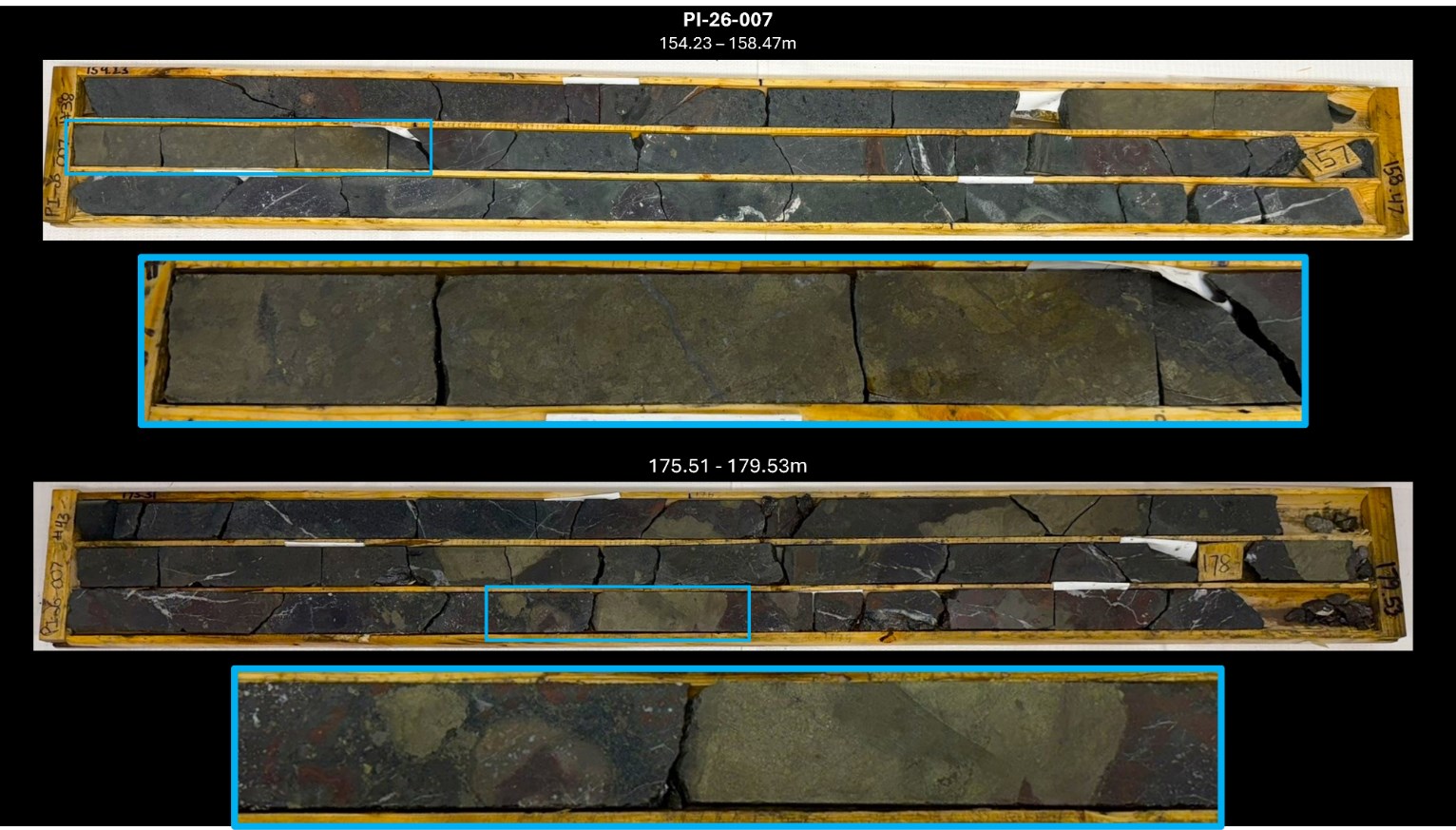
Figure 5 (by HM Exploration): Drill core (lower zone) in hole PI-26-007 from 154.23 – 158.47m and 175.51 – 179.53m downhole. Detailed photo from core box, outlined in blue, highlighting sections of massive sulphide mineralization. See Table 2 for visual descriptions.
To view an enhanced version of this graphic, please visit:
https://images.newsfilecorp.com/files/3027/303333_6326e2eef4cf7ba9_006full.jpg
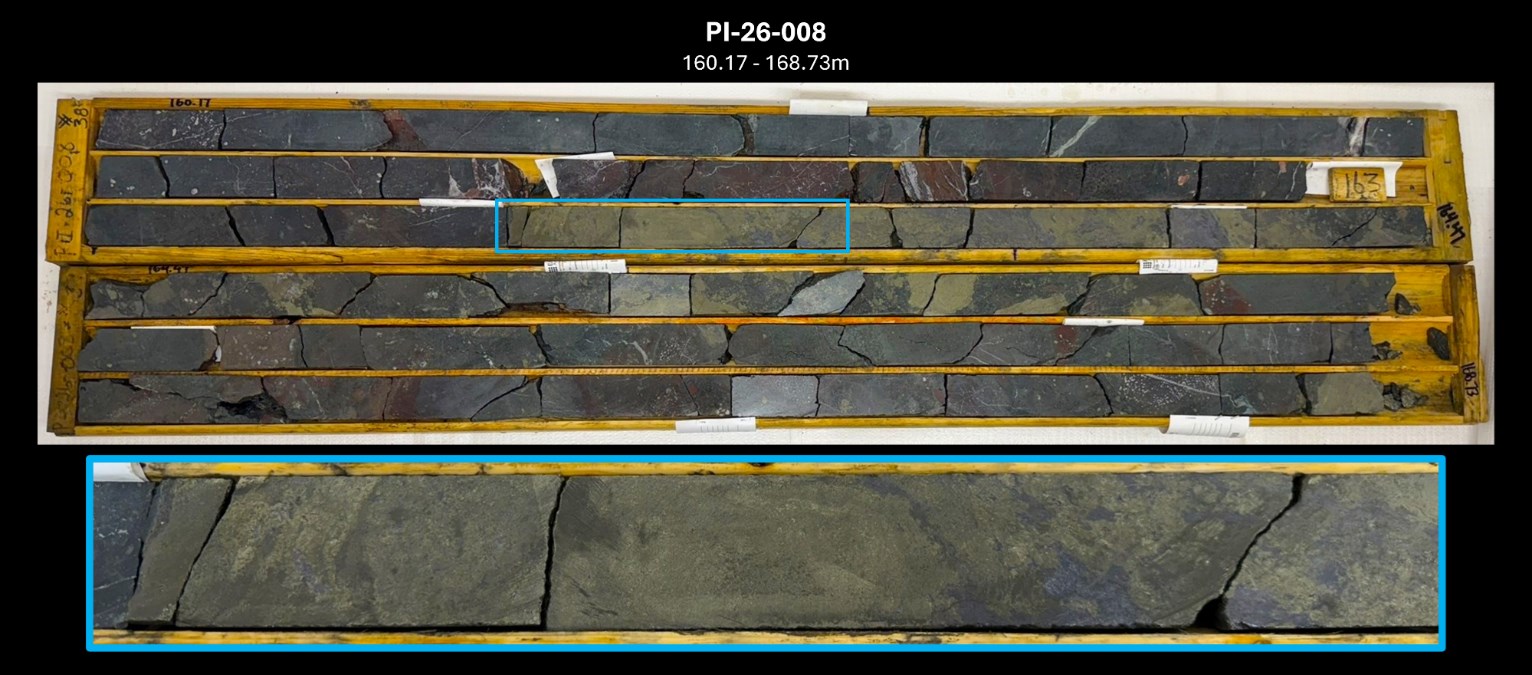
Figure 6 (by HM Exploration): Drill core (lower zone) in hole PI-26-008 from 160.17 – 168.73m downhole. Detailed photo from core box, outlined in blue, highlighting sections of massive sulphide mineralization. See Table 2 for visual descriptions.
To view an enhanced version of this graphic, please visit:
https://images.newsfilecorp.com/files/3027/303333_6326e2eef4cf7ba9_007full.jpg
Table 1 (by HM Exploration): 2026 drill collar data; Coordinates reported in NAD83 – Zone 21N.
| Hole_ID | East | North | Azi | Dip | Depth (m) | Assay Status |
| PI-26-001 | 593296 | 5485437 | 255 | -45 | 187.00 | Pending |
| PI-26-002 | 593269 | 5485422 | 75 | -45 | 199.00 | Pending |
| PI-26-003 | 593269 | 5485422 | 75 | -65 | 199.00 | Pending |
| PI-26-004 | 593269 | 5485422 | 90 | -45 | 151.00 | Pending |
| PI-26-005 | 593281 | 5485460 | 255 | -45 | 352.00 | Pending |
| PI-26-006 | 593281 | 5485460 | 255 | -65 | 133.00 | Pending |
| PI-26-007 | 593264 | 5485472 | 255 | -45 | 191.27 | Pending |
| PI-26-008 | 593264 | 5485472 | 255 | -60 | 220.00 | Pending |
Table 2 (by HM Exploration): Mineralized interval descriptions.
| Hole_ID | From_m | To_m | Length_m | Comments |
| PI-26-006 | 11.4310 | 13.62 | 2.19 | Matrix-dominated debris flow composed of fragments of sub-rounded to angular clasts of massive sulphide (Py + Cpy ± Sph ± Gn) and felsic ± mafic lithic fragments suspended in a matrix of fine-grained sulphide (Py + Cpy ± Sph ± Gn) and milled felsic ± mafic rock |
| PI-26-007 | 7.00 | 10.00 | 3.00 | Predominantly fine-grained disseminated mineralization (Py + Cpy ± Sph ± Gn) observed in matrix |
| 10.00 | 17.00 | 7.00 | Matrix-dominated debris flow composed of fragments of sub-rounded to angular clasts of massive sulphide (Py + Cpy ± Sph ± Gn) and felsic ± mafic lithic fragments suspended in a matrix of fine-grained sulphide (Py + Cpy ± Sph ± Gn) and milled felsic ± mafic rock | |
| 17.00 | 19.00 | 2.00 | Clast-dominated debris zones consisting of sub-rounded to angular fragments of massive sulphide (~85% of intercept) composed of Cpy + Py ± Sph ± Gn suspended in interstitial fine-grained disseminated sulphides (Py + Cpy ± Sph ± Gn) and milled felsic ± mafic rock | |
| 19.00 | 22.00 | 3.00 | Matrix-dominated debris flow composed of fragments of sub-rounded to angular clasts of massive sulphide (Py + Cpy ± Sph ± Gn) and felsic ± mafic lithic fragments suspended in a matrix of fine-grained sulphide (Py + Cpy ± Sph ± Gn) and milled felsic ± mafic rock | |
| 22.00 | 24.18 | 2.18 | Clast-dominated debris zones consisting of sub-rounded to angular fragments of massive sulphide (~85% of intercept) composed of Cpy + Py ± Sph ± Gn suspended in interstitial fine-grained disseminated sulphides (Py + Cpy ± Sph ± Gn) and milled felsic ± mafic rock | |
| 24.18 | 26.41 | 2.23 | Predominantly fine-grained disseminated mineralization (Py + Cpy ± Sph ± Gn) observed in matrix | |
| 26.41 | 27.59 | 1.18 | Clast-dominated debris zones consisting of sub-rounded to angular fragments of massive sulphide (~85% of intercept) composed of Cpy + Py ± Sph ± Gn suspended in interstitial fine-grained disseminated sulphides (Py + Cpy ± Sph ± Gn) and milled felsic ± mafic rock | |
| 27.59 | 28.00 | 0.41 | Predominantly fine-grained disseminated mineralization (Py + Cpy ± Sph ± Gn) observed in matrix | |
| PI-26-007 | 155.31 | 155.97 | 0.66 | Clast-dominated debris zones consisting of sub-rounded to angular fragments of massive sulphide (~85% of intercept) composed of Cpy + Py ± Sph ± Gn suspended in interstitial fine-grained disseminated sulphides (Py + Cpy ± Sph ± Gn) and milled felsic ± mafic rock |
| PI-26-007 | 176.85 | 179.00 | 2.15 | Clast-dominated debris zones consisting of sub-rounded to angular fragments of massive sulphide (~25% of intercept) composed of Cpy + Py ± Sph ± Gn suspended in interstitial fine-grained disseminated sulphides (Py + Cpy ± Sph ± Gn) and milled felsic ± mafic rock |
| PI-26-008 | 7.55 | 12.52 | 4.97 | Matrix-dominated debris flow composed of fragments of sub-rounded to angular clasts of massive sulphide (Py + Cpy ± Sph ± Gn) and felsic ± mafic lithic fragments suspended in a matrix of fine-grained sulphide (Py + Cpy ± Sph ± Gn) and milled felsic ± mafic rock |
| PI-26-008 | 15.00 | 16.26 | 1.26 | Predominantly fine-grained disseminated mineralization (Py + Cpy ± Sph ± Gn) observed in matrix |
| 16.26 | 23.40 | 7.14 | Matrix-dominated debris flow composed of fragments of sub-rounded to angular clasts of massive sulphide (Py + Cpy ± Sph ± Gn) and felsic ± mafic lithic fragments suspended in a matrix of fine-grained sulphide (Py + Cpy ± Sph ± Gn) and milled felsic ± mafic rock | |
| 23.40 | 24.87 | 1.47 | Clast-dominated debris zones consisting of sub-rounded to angular fragments of massive sulphide (~85% of intercept) composed of Cpy + Py ± Sph ± Gn suspended in interstitial fine-grained disseminated sulphides (Py + Cpy ± Sph ± Gn) and milled felsic ± mafic rock | |
| 24.87 | 28.00 | 3.13 | Predominantly fine-grained disseminated mineralization (Py + Cpy ± Sph ± Gn) observed in matrix | |
| PI-26-008 | 163.45 | 164.27 | 0.82 | Clast-dominated debris zones consisting of sub-rounded to angular fragments of massive sulphide (~85% of intercept) composed of Cpy + Py ± Sph ± Gn suspended in interstitial fine-grained disseminated sulphides (Py + Cpy ± Sph ± Gn) and milled felsic ± mafic rock |
| 164.27 | 166.00 | 1.73 | Matrix-dominated debris flow composed of fragments of sub-rounded to angular clasts of massive sulphide (Py + Cpy ± Sph ± Gn) and felsic ± mafic lithic fragments suspended in a matrix of fine-grained sulphide (Py + Cpy ± Sph ± Gn) and milled felsic ± mafic rock | |
| 166.00 | 168.55 | 2.55 | Patchy sections of predominantly fine-grained disseminated mineralization (Py + Cpy ± Sph ± Gn) observed in matrix | |
| 168.55 | 169.00 | 0.45 | Clast-dominated debris zones consisting of sub-rounded to angular fragments of massive sulphide (~85% of intercept) composed of Cpy + Py ± Sph ± Gn suspended in interstitial fine-grained disseminated sulphides (Py + Cpy ± Sph ± Gn) and milled felsic ± mafic rock | |
| 169.00 | 170.22 | 1.22 | Matrix-dominated debris flow composed of fragments of sub-rounded to angular clasts of massive sulphide (Py + Cpy ± Sph ± Gn) and felsic ± mafic lithic fragments suspended in a matrix of fine-grained sulphide (Py + Cpy ± Sph ± Gn) and milled felsic ± mafic rock |
Geology & Mineralization (as stated by HM Exploration)
The Project is located within the Notre Dame Subzone of the Dunnage Tectonostratigraphic Zone. Of note, most of the Project is underlain by Ordovician submarine volcanic rocks of the Roberts Arm Group which is regionally identified as part of a mature arc sequence referred to as the Buchans-Roberts Arm Belt that also hosts the historic Buchans mine (after Dunning et Al., 1987). Mineralization occurs as lower grade (Spencer’s Dock); medium grade (Old Mines); and high grade (3B-Zone/Clifford Jones) deposits that are of both sub-seafloor replacement and exhalative varieties. The deposits are often flanked by extensive chlorite, sericite, silica, K-feldspar and epidote alteration often observed in bimodal-felsic VMS systems. The Spencer’s Dock area displays sericite/silica alteration that generally increases in intensity near mineralized zones, while the 3B/Old Mine areas display sericite/silica alteration that is abundant but less widespread and is more intense when proximal to mineralized zones (after Kerr, 1996).
VMS deposits are a globally significant source of copper, zinc, lead, silver, and gold. The Project’s geology shares key characteristics with known Volcanogenic Massive Sulphide (“VMS“) districts in Newfoundland, including the past producing Buchans, Ming and Rambler Mines, supporting the exploration potential of the Project.
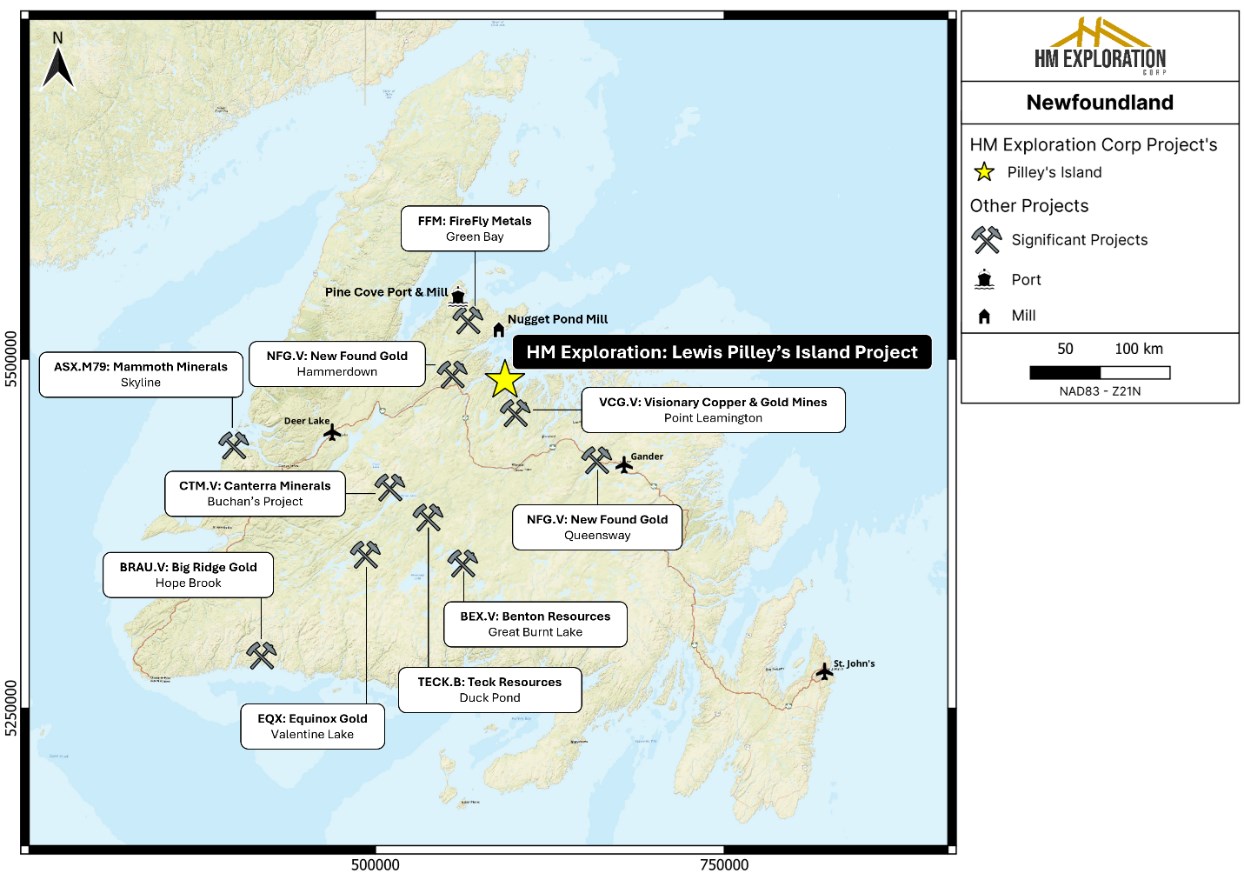
Figure 7 (by HM Exploration): Regional map of Newfoundland displaying the location of the Property and other significant mineral exploration and mining projects in Newfoundland – Canada.
To view an enhanced version of this graphic, please visit:
https://images.newsfilecorp.com/files/3027/303333_6326e2eef4cf7ba9_008full.jpg
About the Lewis Pilley’s Project (as stated by HM Exploration)
The Project is road accessible and situated approximately twenty-five (25) km east of the town of Springdale, approximately fifty-five (55) km southeast of Firefly Metals’ Green Bay Project and approximately one hundred fifty (150) km from the Pine Cove Mill and Port by way of major roads (Figure 7).
The Project has a long history of mining and exploration dating back to the late 1800s when the Pilley’s Island Pyrite Company Ltd. produced approximately 450,000 tonnes of massive pyritic ore from the Pilley’s Island Mine-Old Mines (after Kerr, 1996).
The Project hosts a cluster of VMS systems and prospects with demonstrated high-grade Zn-Pb-Cu-Ag+/-Au intersections. Mineralization is typical bimodal-felsic VMS, with both massive sulphide and sulphide-clast breccias (Thurlow, 1996). The geological setting is directly analogous to the Buchans camp (Thurlow, 1996), and the presence of sulphide-clast breccias is a strong vector toward proximal massive sulphide lens.
Most of the historic showings that fall within the extent of the Project have not seen systematic exploration. Many of the historic drill holes were shallow and drilled in a vertical orientation limiting the geological knowledge of the extents of the underlying lithology and mineralization. Work is being planned to validate historic assay results as well as collect new data from the 3B-Zone, Clifford Jones (Bull Road) Extension, Bouzanne Shaft, Henderson, Mansfield and Pilley’s Cove Showings.
Sampling, Preparation & QA/QC (as stated by HM Exploration)
Drill collar locations were determined from hand-held GPS (NAD83-Zone 21N) and the drill rig was aligned using a Reflex TN-14 Gyrocompass alignment tool. All samples are given a unique sample ID and number and shipped directly to Eastern Analytical Ltd. (403 Little Bay Road, Springdale, NL), a commercial laboratory that is ISO/IEC 17025 accredited and completely independent of HM Exploration and Great Atlantic. Analytical methods include ICP-OES (34 element) with four-acid digestion, Au Fire Assay (30g) with AA finish, and Ore Grade Assay (multi-acid digestion) with AA finish. The Company inserts standard, blank, and duplicate samples as part of its standard QA/QC procedures.
National Instrument 43-101 Disclosure (as stated by HM Exploration)
Nicholas Rodway, P.Geo, (Licence# 46541) (Permit to Practice# 1000359) is CEO and Director of HM Exploration, and a qualified person as defined by National Instrument 43-101- Standards of Disclosure for Mineral Projects. Mr. Rodway has supervised the preparation, verified and approved the technical content in this news release. Verification included review of drill logs, sample tags, chain of custody procedures and analytical protocols. No limitations were noted during the verification process.
References
Dunning, G.R., Kean, B.F., Thurlow, J.G and Swinden, H.S. (1987): Geochronology of the Buchans, Roberts Arm and Victoria Lake Groups and Mansfield Cove Complex, Newfoundland. Canadian Journal of Earth Sciences, Volume 24, pages 1175-1184.
Kerr, A. (1996) New perspectives on the stratigraphy, volcanology, and structure of the island-arc volcanic rocks in the Ordovician Roberts Arm Group, Notre Dame Bay. In Current Research, Newfoundland Department of Natural Resources, Geological Survey, Report 96-1, pages 283-310.
Thurlow, J.G (1996): Geology of a newly discovered cluster of blind massive sulphide deposits, Pilley’s Island, central Newfoundland. In Current Research, Newfoundland Department of Natural Resources, Geological Survey, Report 96-1, pages 181- 189.
David Martin, P.Geo., (New Brunswick and Newfoundland and Labrador), a Qualified Person as defined by NI 43-101 and VP Exploration for Great Atlantic, reviewed and approved the technical information contained in this News Release. Great Atlantic has not verified sulphide bearing drill core intervals stated in this news release.
On Behalf of the board of directors
“Christopher R. Anderson”
Mr. Christopher R. Anderson
President CEO Director
604-488-3900
Investor Relations:
1-416-628-1560
IR@GreatAtlanticResources.com
___
Never miss an update!
Follow Great Atlantic Resources Corp. on social media for project updates, photos, and much more.
LINKEDIN: https://ca.linkedin.com/company/greatatlanticresources
X: https://x.com/GreatAtlRes
FACEBOOK: https://www.facebook.com/GreatAtlanticResources
INSTAGRAM: https://www.instagram.com/greatatlanticresources/
YOUTUBE: https://www.youtube.com/@GreatAtlanticTV/
TIKTOK: https://www.tiktok.com/@greatatlanticresources

To view an enhanced version of this graphic, please visit:
https://images.newsfilecorp.com/files/3027/303333_6326e2eef4cf7ba9_009full.jpg
About Great Atlantic Resources Corp.: Great Atlantic Resources Corp. is a Canadian exploration company focused on the discovery and development of mineral assets in the resource-rich and sovereign risk-free realm of Atlantic Canada, one of the number one mining regions of the world. Great Atlantic is currently surging forward building the company utilizing a Project Generation model, with a special focus on the most critical elements on the planet that are prominent in Atlantic Canada, Gold, Copper, Zinc, Nickel, Cobalt, Antimony and Tungsten.
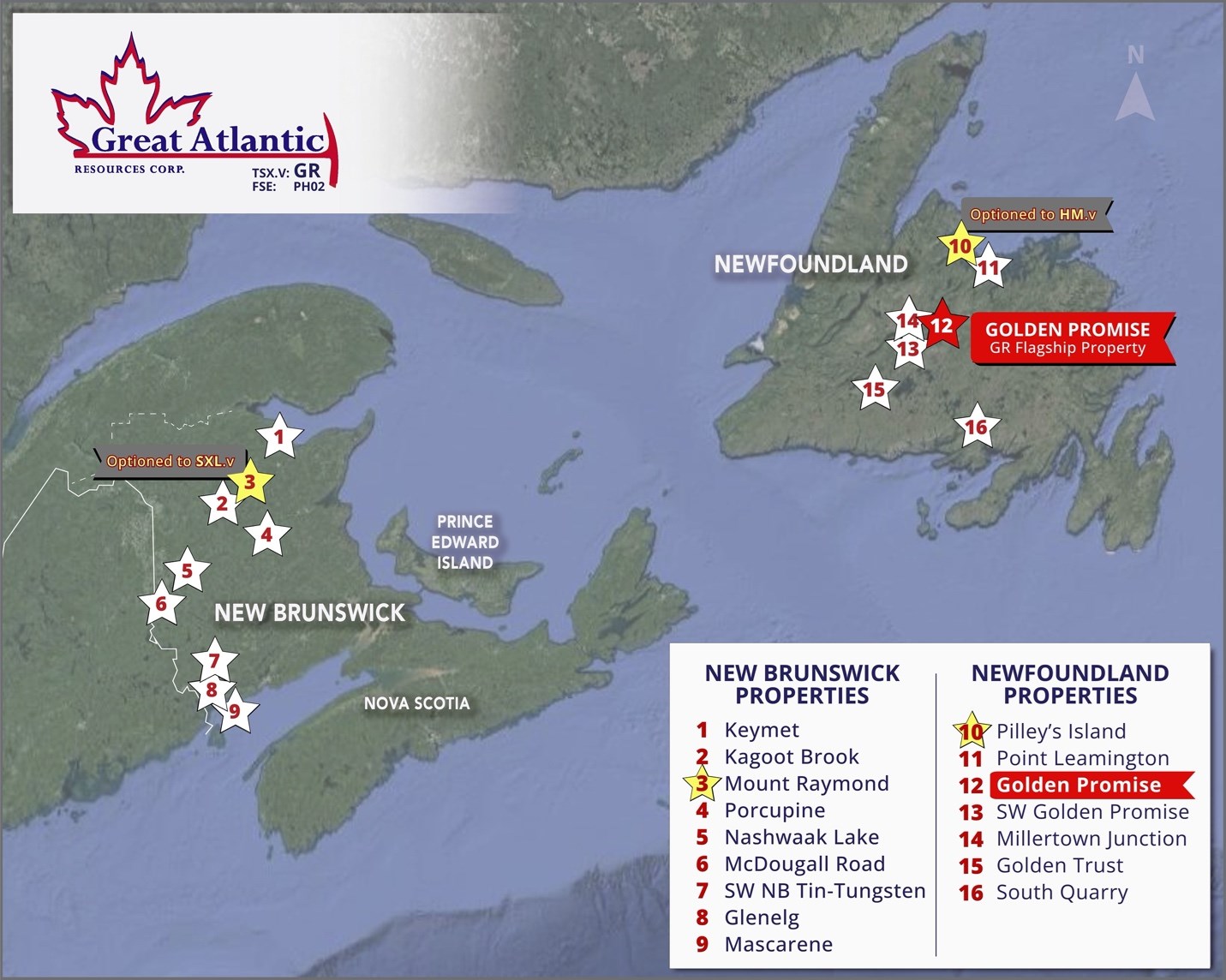
To view an enhanced version of this graphic, please visit:
https://images.newsfilecorp.com/files/3027/303333_6326e2eef4cf7ba9_010full.jpg
This press release includes certain statements that may be deemed “forward-looking statements”. All statements in this release, other than statements of historical facts, that address future exploration drilling, exploration activities and events or developments that the Company expects, are forward-looking statements. Although the Company believes the expectations expressed in such forward-looking statements are based on reasonable assumptions, such statements are not guarantees of future performance and actual results or developments may differ materially from those in forward-looking statements. Factors that could cause actual results to differ materially from those in forward-looking statements include exploitation and exploration successes, continued availability of financing, and general economic, market or business conditions.
Neither TSX Venture Exchange nor its Regulation Services Provider (as that term is defined in the policies of the TSX Venture Exchange) accepts responsibility for the adequacy or accuracy of this release.
Great Atlantic Resource Corp.
888 Dunsmuir Street – Suite 888, Vancouver, B.C., V6C 3K4