




Vancouver, British Columbia–(Newsfile Corp. – July 8, 2026) – Lunex Metals Corp. (“Lunex” or the “Company”) is pleased to report assay results from seven diamond drill holes completed at the Orion and Estrella del Norte targets as part of its 2026 drill program at the Luna Roja Project (“Luna Roja” or the “Project”), located in Santa Cruz Province, Argentina.
The reported results correspond to holes LR_DDH18, LR_DDH19, LR_DDH26 and LR_DDH27 at Estrella del Norte, and LR_DDH23, LR_DDH24 and LR_DDH25 at Orion. These targets are distributed along the Vía Láctea structural corridor, a northwest-trending mineralized structure extending for approximately 2.8 kilometres, which represents the principal exploration trend identified at the Project.
On July 2, 2026, the Company reported initial drill results from the Cruz del Sur target, where drilling confirmed the presence of a large-scale gold-silver epithermal system developed along the Vía Láctea structural corridor. The results presented in this release complete the 2026 drill program and correspond to the Orion and Estrella del Norte targets.
Joaquin Mignaquy, President and CEO of Lunex Metals, commented:
“The Estrella del Norte results are particularly encouraging as they confirm the presence of a new mineralized center located more than two kilometres north of Cruz del Sur. Drilling identified mineralized intervals associated with silicification, hydrothermal alteration and structures related to the Vía Láctea corridor, demonstrating that the system extends beyond the area initially defined.
In addition, drilling at Orion has helped define the geometry of the Vía Láctea structural corridor with greater precision, particularly through the intersection of the structural and lithological contact between volcaniclastics and domes associated with the main fault. This information will be critical in guiding future drilling along one of the principal structural controls of the system.”
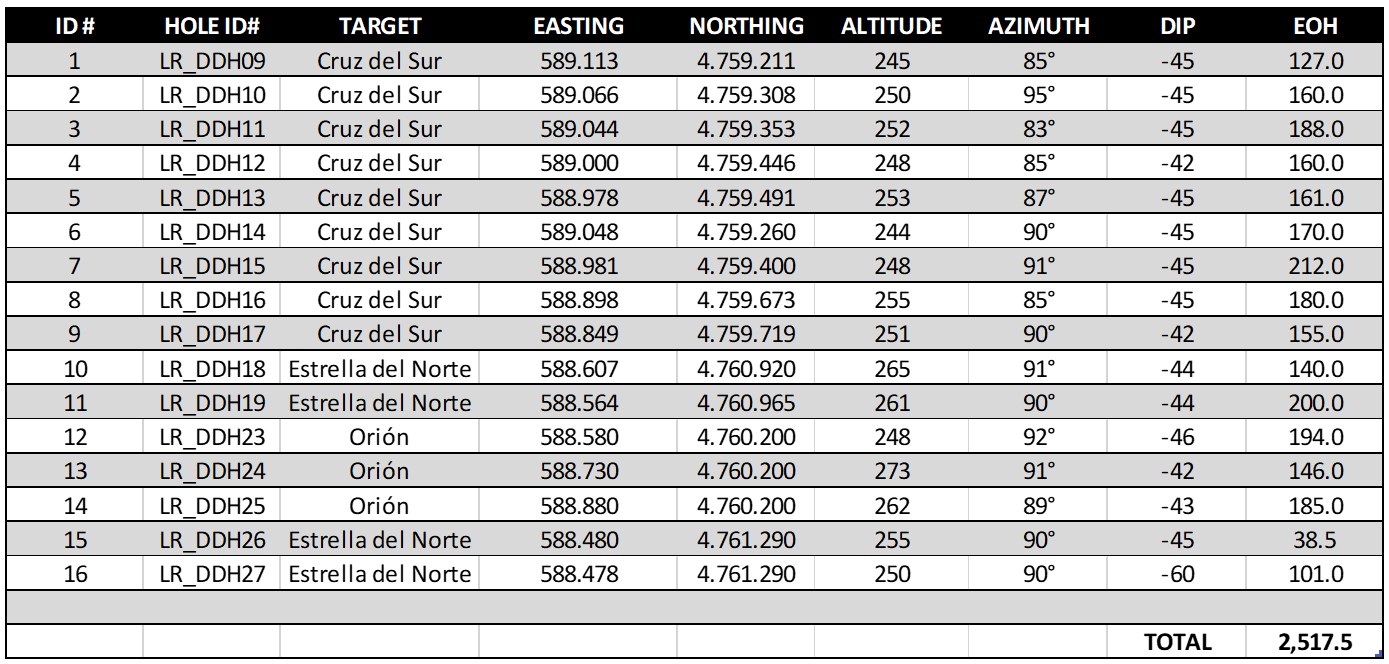
TABLE 1. COLLAR LOCATIONS OF THE 2026 DRILL PROGRAM AT THE LUNA ROJA PROJECT
To view an enhanced version of this graphic, please visit:
https://images.newsfilecorp.com/files/12524/304378_tab1.jpg
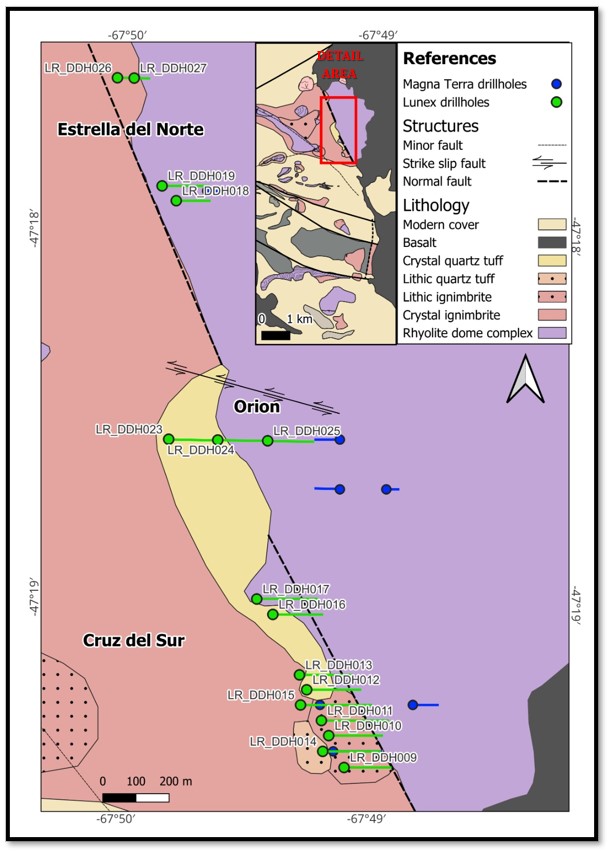
FIGURE 1. GEOLOGICAL MAP OF THE VÍA LÁCTEA STRUCTURAL CORRIDOR SHOWING THE LOCATION OF REPORTED DRILL HOLES AND PRINCIPAL TARGETS AT THE LUNA ROJA PROJECT
To view an enhanced version of this graphic, please visit:
https://images.newsfilecorp.com/files/12524/304378_fig1.jpg
ESTRELLA DEL NORTE DRILL RESULTS
A total of four diamond drill holes were completed at Estrella del Norte. Holes LR_DDH26 and LR_DDH27 were designed to test the structural and lithological contact between the hanging wall volcaniclastics and the footwall dome complex along the Vía Láctea Fault.
Hole LR_DDH26 was abandoned prematurely at 38.5 metres due to tool loss within a fault zone, while LR_DDH27, drilled from the same platform at a steeper inclination, successfully intersected the full width of the mineralized system.
Holes LR_DDH18 and LR_DDH19 were designed to test hydrothermal breccia structures developed entirely within the dome complex and confirm a mineralized hydrothermal breccia corridor developed within the footwall of the Vía Láctea system.
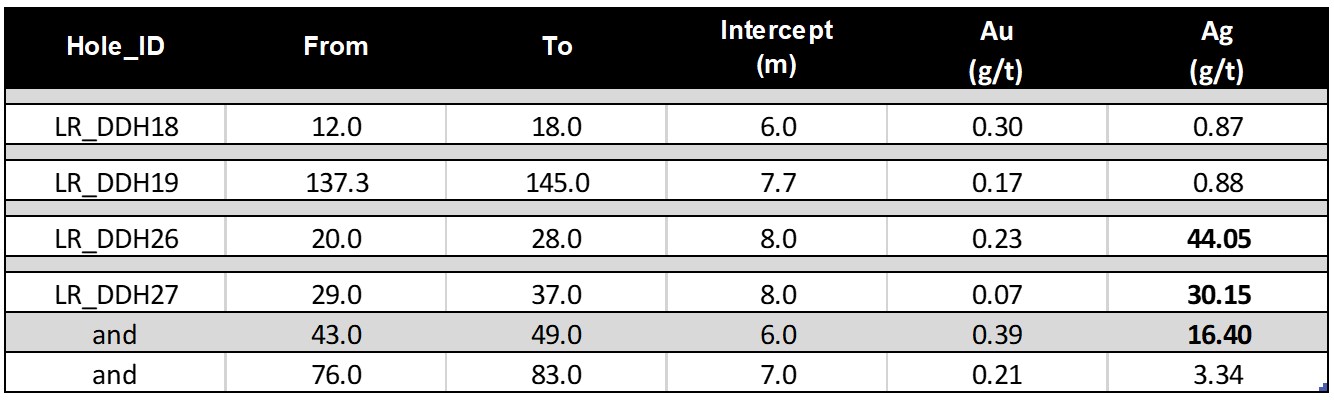
Results from this sector confirm the presence of gold and silver mineralization associated with hydrothermal breccias, stockworks and veinlets. Highlight intercepts include 8.0 metres grading 0.23 g/t Au and 44.05 g/t Ag in LR_DDH26; multiple mineralized intervals in LR_DDH27, including 8.0 metres grading 0.07 g/t Au and 30.15 g/t Ag, 6.0 metres grading 0.39 g/t Au and 16.40 g/t Ag, and 7.0 metres grading 0.21 g/t Au and 3.34 g/t Ag; as well as 6.0 metres grading 0.30 g/t Au and 0.87 g/t Ag in LR_DDH18, and 7.7 metres grading 0.17 g/t Au and 0.88 g/t Ag in LR_DDH19.
The presence of relatively elevated silver values compared to much of the drilling completed at Cruz del Sur suggests geochemical variations within the hydrothermal system and supports the interpretation that Estrella del Norte represents a second mineralized center within the Vía Láctea corridor.
As part of the ongoing geological review of the 2026 drill program, the Company identified several unsampled core intervals within broader mineralized zones associated with some of the reported intercepts. Given the significant widths and continuity of mineralization encountered, these intervening intervals are being systematically cut, sampled, and submitted for assay in order to complete the evaluation of the mineralized system. Results from this additional sampling will be reported once received, validated, and interpreted.
TABLE 2. HIGHLIGHT RESULTS FROM THE CURRENT DRILL PROGRAM AT THE ESTRELLA DEL NORTE TARGET
To view an enhanced version of this graphic, please visit:
https://images.newsfilecorp.com/files/12524/304378_tab2.jpg
*Reported drill intercepts represent downhole lengths. True widths are not yet estimated due to the current limited understanding of the geometry of the mineralized zones.
ORION RESULTS
Holes LR_DDH23, LR_DDH24 and LR_DDH25 tested the central segment of the Vía Láctea structural corridor located between Cruz del Sur and Estrella del Norte. While drilling did not intersect significant gold or silver intervals, hole LR_DDH23 successfully intersected the Vía Láctea Fault, precisely identifying the structural and lithological contact between Jurassic volcaniclastics and the rhyolitic-dacitic dome complex.
This intersection represents a key element for refining the geometry of the corridor and improving the positioning of future drill holes designed to test this contact, which is interpreted as one of the principal controls on mineralization within the system.
GEOLOGICAL INTERPRETATION
Results from Estrella del Norte confirm the presence of a second mineralized center within the Vía Láctea structural corridor, located approximately 2.0 km north of Cruz del Sur, consolidating the continuity of a mineralized hydrothermal system extending for at least 2.8 kilometres. Mineralization is associated with silicification, quartz stockworks, hydrothermal breccias and veinlets developed within both Jurassic volcaniclastics and the rhyolitic-dacitic dome complex.
Drill results obtained along the Vía Láctea corridor confirm not only lateral continuity, but also the development of broad zones of hydrothermal alteration, stockworks, breccias and mineralized veinlets. At Cruz del Sur, mineralization is associated with a moderately west-dipping structure, while at Estrella del Norte the system evolves into steeper to subvertical geometries, suggesting structural variations within the same hydrothermal architecture.
The significantly higher silver values obtained at Estrella del Norte relative to Cruz del Sur suggest possible vertical and/or lateral variations within the epithermal system, potentially reflecting differences in preservation level or structural-fluid controls along the Vía Láctea corridor.
Elevated arsenic values identified at Estrella del Norte, combined with mercury anomalies previously recognized at surface and the nature of hydrothermal alteration, remain consistent with relatively shallow levels of a preserved low-sulphidation epithermal system, maintaining open potential to identify higher-grade zones at depth along the Vía Láctea corridor.
ABOUT THE LUNA ROJA PROJECT
The Luna Roja Project is located in Santa Cruz Province, Argentina, within the Deseado Massif, one of South America’s most prospective geological provinces for epithermal gold-silver deposits.
The Project hosts a series of structurally controlled gold-silver targets developed within Jurassic volcanic rocks. The principal exploration trend identified to date is the Vía Láctea structural corridor, a northwest-trending mineralized corridor approximately 2.8 kilometres in length that includes the Cruz del Sur, Orion and Estrella del Norte target areas.
QA/QC
Drill core samples were obtained by longitudinally sawing the diamond drill core, with one-half retained as a reference sample. Samples were submitted to Alex Stewart International Argentina S.A. in San Julián, Santa Cruz Province, for sample preparation and analysis.
Gold analyses were completed by fire assay with AA finish, while silver and multi-element analyses were determined by acid digestion and ICP methods.
The QA/QC program included the systematic insertion of blanks, certified reference materials and duplicates within the analytical sequence in accordance with the Company’s internal quality control procedures.
QUALIFIED PERSON
The scientific and technical information contained in this press release has been reviewed and approved by Fernando Ganem, P.Geo., Vice President Exploration of Lunex Metals Corp., who acts as a “Qualified Person” as defined under National Instrument 43-101 – Standards of Disclosure for Mineral Projects. Mr. Ganem has reviewed the sampling and QA/QC procedures and results as verification of the data disclosed in this new release.
ABOUT LUNEX METALS CORP.
Lunex Metals Corp. is a Canadian mineral exploration company focused on advancing the Luna Roja Project in the prolific Deseado Massif region of Santa Cruz Province, Argentina. The Company is committed to the discovery and development of high-grade precious metal deposits through systematic exploration and technical excellence. Lunex is a British Columbia, Canada corporation and a reporting issuer in the Provinces of British Columbia and Alberta, and is progressing toward listing its common shares on the TSX Venture Exchange.
For further information, please contact:
Joaquin Mignaquy CEO
Phone: +54 9 11 6913-9449
Email: joaquin.mignaquy@Andina360.com
Cautionary Statements
All statements in this press release, other than statements of historical fact, are “forward-looking information” with respect to the Company within the meaning of applicable securities laws. Forward-looking information is frequently characterized by words such as “plan”, “expect”, “project”, “intend”, “believe”, “anticipate”, “estimate” and other similar words, or statements that certain events or conditions “may” or “will” occur. Forward-looking statements are based on the opinions and estimates at the date the statements are made, and are subject to a variety of risks and uncertainties and other factors that could cause actual events or results to differ materially from those anticipated in the forward-looking statements. There are uncertainties inherent in forward-looking information, including factors beyond the Company’s control. There are no assurances that the business plans described in this news release will come into effect on the terms or time frame described herein. The Company undertakes no obligation to update forward-looking information if circumstances or management’s estimates or opinions should change except as required by law. For a description of the risks and uncertainties facing the Company and its business and affairs, readers should refer to the Company’s disclosure filings with Canadian securities regulators, which are posted on the Company’s profile at www.sedarplus.ca.
NOT FOR DISTRIBUTION TO U.S. NEWSWIRE SERVICES OR FOR RELEASE, PUBLICATION, DISTRIBUTION OR DISSEMINATION DIRECTLY, OR INDIRECTLY, IN WHOLE OR IN PART, IN OR INTO THE UNITED STATES.