




Toronto, Ontario–(Newsfile Corp. – May 4, 2026) – Kirkland Lake Discoveries Corp. (TSXV: KLDC) (OTCQB: KLKLF) (“KLDC” or the “Company”) is pleased to announce assay results from its ongoing 2026 diamond drilling program at the past-producing Mirado property, located 20 km southeast of Kirkland Lake, Ontario.
Highlights:
KLM26-003
- 0.87 g/t Au over 27 m from 13 m to 40 m
- 0.26 g/t Au over 16 m from 81.5 m to 97.5 m
- 0.25 g/t Au over 32.9 m from 112.6 m to 145.5 m
KLM26-004
- 39.35 g/t Au over 16.4 m from 53.6 m to 70 m, including:
- 106.9 g/t Au over 6.0 m from 55 m
- and including 1,670 g/t Au over 0.38 m from 58.62 m
- 2.22 g/t Au over 26.1 m from 78.7 m to 104.8 m, including:
- 3.75 g/t Au over 13.5 m from 91.3 m
- 40-m step out south from hole KLM26-002
- High-grade mineralization
- Six holes pending using Chrysos PhotonAssay™ for expedited results
Results from drill hole KLM26-004, located approximately 40 metres southeast of KLM26-002, confirm the lateral continuity of the South Zone mineralized system and demonstrate the presence of high-grade shoots within the broader mineralized envelope with geological continuity (see Figure 1). Drill hole KLM26-003, positioned between KLM26-001 and KLM26-002, returned 0.87 g/t Au over 27 m from 13 m, 0.26 g/t Au over 16 m from 81.5 m, and 0.25 g/t Au over 32.9 m from 112.6 m, further supporting continuity of the mineralized envelope along strike (see Table 1). The combination of the broad, continuous mineralization intersected in KLM26-002 (1.01 g/t Au over 121 m) and the higher-grade, visible gold-bearing intervals in KLM26-004 (see Figure 2 and Figure 3) highlights the role of structural controls, sulphide concentration, and quartz-carbonate veining in upgrading gold grades within the system.
Chief Executive Officer, Stefan Sklepowicz, commented, “As we progress into new areas at Mirado, we are seeing the exact geological signatures we had hoped for, broad, continuous mineralization punctuated by high-grade intercepts. KLM26-004 clearly demonstrates the potential of this system. With six additional holes pending, we are eager to see how these results continue to define the scale of this project.”
Executive Chairman, Denis Laviolette, commented, “Historically, Mirado was interpreted as a series of discrete, stacked lenses. Our recent drilling, however, demonstrates that gold mineralization is far more continuous, with significant values bridging previously separated zones.
Notably, we have identified localized high-grade gold (>1,600 g/t Au) within quartz-carbonate vein networks. While these high-grades impact composite intervals, we believe premature grade capping would misrepresent the deposit’s true geological nature. It is now clear that gold is concentrated along structurally controlled networks within a large, continuous system, providing a scalable model to systematically vector toward high-grade shoots and expand the project’s overall footprint.”
Table 1 – Drill Results
| Drill Hole | From (m) | To (m) | Interval (m) | Au (g/t) | Zone |
| KLM26-003 | 13.0 | 40.0 | 27.0 | 0.87 | South Zone |
| including | 13.0 | 18.0 | 5.0 | 3.43 | South Zone |
| and | 81.5 | 97.5 | 16.0 | 0.26 | South Zone |
| and | 112.6 | 145.5 | 32.9 | 0.25 | South Zone |
| KLM26-004 | 15.0 | 18.6 | 3.6 | 1.23 | South Zone |
| 53.6 | 70.0 | 16.4 | 39.35 | South Zone | |
| including | 55.0 | 61.0 | 6.0 | 106.90 | South Zone |
| and including | 58.6 | 59.0 | 0.38 | 1,670 | South Zone |
| 78.7 | 104.8 | 26.1 | 2.22 | South Zone | |
| including | 91.3 | 104.8 | 13.5 | 3.75 | South Zone |
| Reported intervals are calculated using a weighted average grade with a 0.2 g/t Au cutoff. To reflect the continuity of mineralization within the broader system, up to 3.0 m of internal dilution (consecutive material below cutoff) is included within reported composites. True widths are estimated at approximately 80% of the reported core length intervals. At this stage, no top-cutting has been applied to high-grade results. While the company acknowledges that the reported composite is significantly influenced by a single high-grade sample, applying an arbitrary cap is considered premature. Further drilling is required to generate a robust dataset for variographic analysis, which will be used to mathematically determine appropriate grade capping for future resource estimations. | |||||
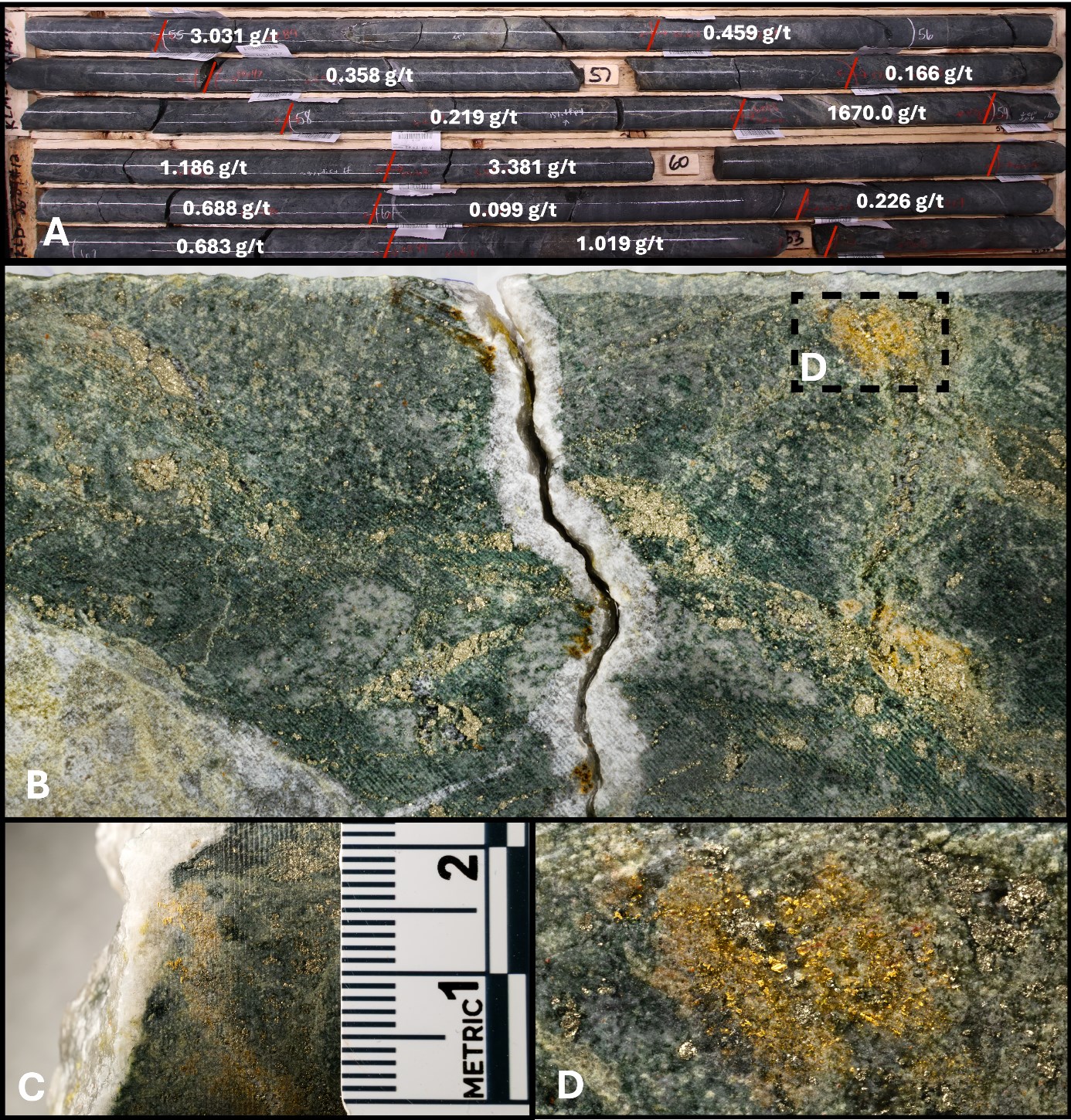
Figure 1 – Drill core from KLM26-004: A – From 54.80 m to 63.37 m broad mineralization including high-grade interval within agglomerate. B – From 58.62 m to 59 m multiple occurrences of visible gold. C – Reverse side of core at 58.81 m with visible gold. D – Close up image of pervasive visible gold at 58.86 m.
To view an enhanced version of this graphic, please visit:
https://images.newsfilecorp.com/files/5701/295712_4ac166f61437c8fb_001full.jpg
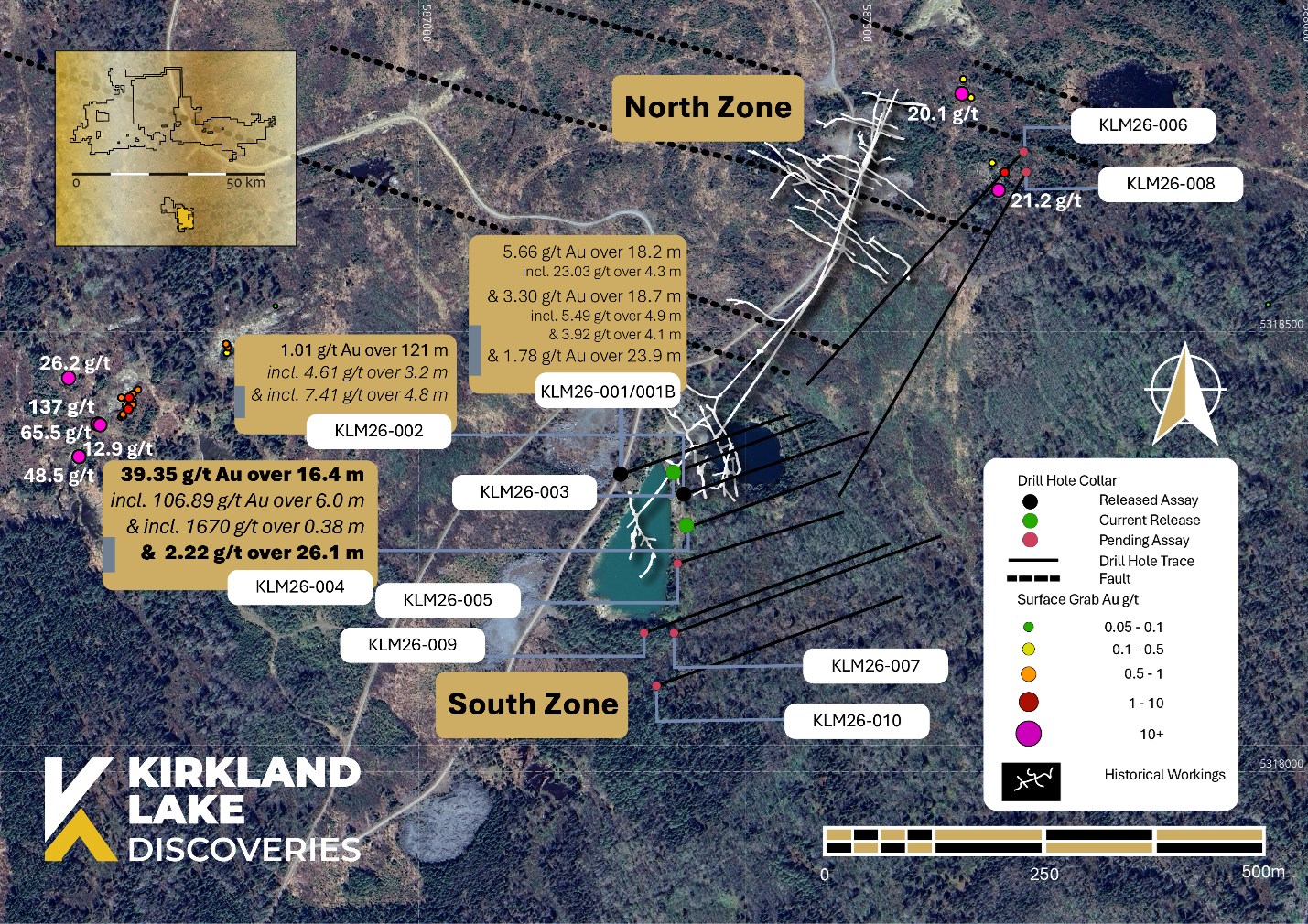
Figure 2 – Drill collar locations at Mirado property. KLDC is systematically testing the lateral and depth extents of the South Zone as well as testing mineralization in the North Zone. High-grade surface grab samples were not systematically tested and represent a significant resource expansion opportunity. Historical workings are shown in white where exploration drifting was completed into the South Zone in the late 1980s. Commercial production did not commence due to the stock market crash in 1987.
To view an enhanced version of this graphic, please visit:
https://images.newsfilecorp.com/files/5701/295712_4ac166f61437c8fb_002full.jpg
Mineralization Style and Geological Context
Mineralization reported herein is associated with the South Zone and is hosted within intermediate volcanic units, characterized by quartz-carbonate stringer systems with 1-5% disseminated pyrite and strong local vein replacement (locally up to 90%). In drill hole KLM26-004, mineralization is developed within a medium grey-green, massive fragmental agglomerate, with a chlorite-dominant matrix and sericite-altered fragments. Quartz-carbonate stringers are locally irregular and strongly associated with elevated sulphide content and visible gold, including eight instances of visible gold observed on and adjacent to a quartz-carbonate stringer at approximately 58.86 m. Sulphide mineralization consists of fine-grained disseminated and fracture-filled pyrite (1-5%), locally increasing to semi-massive concentrations over short intervals.
Alteration is dominated by pervasive chlorite-carbonate with localized sericite, silicification, and epidote, with minor chalcopyrite occurring in more strongly altered intervals. This mineralization style reflects a structurally controlled vein and stringer system developed within a broadly altered volcanic host, with gold preferentially concentrated along zones of enhanced permeability, including quartz-carbonate veining and associated sulphide enrichment.
Lithology and Alteration Controls on Mineralization
Kirkland Lake Discoveries Corp. is advancing a refined understanding of the lithological and alteration controls on gold mineralization within the South Zone, where mineralization is hosted across multiple volcanic units and exhibits strong structural and lithological controls. Results to date highlight a clear relationship between host rock competency, structural preparation, and hydrothermal alteration in driving gold concentration.
Agglomerates represent the principal host to high-grade mineralization, returning the highest grades and greatest frequency of elevated gold values, including the majority of samples exceeding 4 g/t Au. Intermediate and felsic crystal tuffs also return elevated average grades and are interpreted to represent key rheological contrasts where deformation and folding have enhanced permeability and focused gold-bearing fluids. Conversely, intermediate tuffs and lapilli tuffs define a broader, lower-grade mineralized envelope, while mafic units remain comparatively under-mineralized.
Across all lithologies, metasomatism is the dominant alteration process, with silica, chlorite, and quartz-carbonate assemblages showing the strongest association with elevated gold values. Higher-grade mineralization consistently coincides with zones where these alteration assemblages overprint structurally prepared rocks.
Table 2 summarizes gold distribution by lithology and associated alteration assemblages within the South Zone and highlights the strong correlation between gold mineralization, agglomerate and crystal tuff host rocks, and silica-chlorite-quartz-carbonate alteration systems.
Table 2 – Gold Distribution by Lithology and Associated Alteration, South Zone
| Lithology | Total assayed length m | Weighted average Au g/t | Max Au g/t | Samples >=0.1 g/t | Samples >=0.5 g/t | Samples >=1.0 g/t | Samples >=4.0 g/t | Gold-bearing top alteration |
| Agglomerate | 320.1 | 0.72 | 1670.00 | 208 | 43 | 26 | 10 | Metasomatism (40.0m); Silica (38.9m); Chlorite (21.6m); Sericite (15.1m); Epidote (10.1m); Qtz-Carb (5.8m) |
| Intermediate Tuff | 154.3 | 0.35 | 11.86 | 110 | 25 | 13 | 5 | Metasomatism (37.4m); Sericite (34.1m) |
| Intermediate Lapilli Tuff | 262.5 | 0.18 | 15.08 | 91 | 18 | 5 | 3 | Metasomatism (21.7m); Qtz-Carb (21.0m); Chlorite (11.8m); Silica (7.6m); Sericite (1.1m) |
| Intermediate Crystal Tuff | 71.3 | 1.45 | 84.36 | 64 | 20 | 10 | 2 | Metasomatism (39.2m); Silica (3.2m) |
| Mafic Crystal Tuff | 42.2 | 0.18 | 0.75 | 28 | 8 | 0 | 0 | Metasomatism (9.7m); Silica (4.5m); Chlorite (3.2m); Qtz-Carb (2.7m) |
| Felsic Crystal Tuff | 45.1 | 1.06 | 47.39 | 21 | 10 | 5 | 2 | Metasomatism (14.1m); Qtz-Carb (1.9m) |
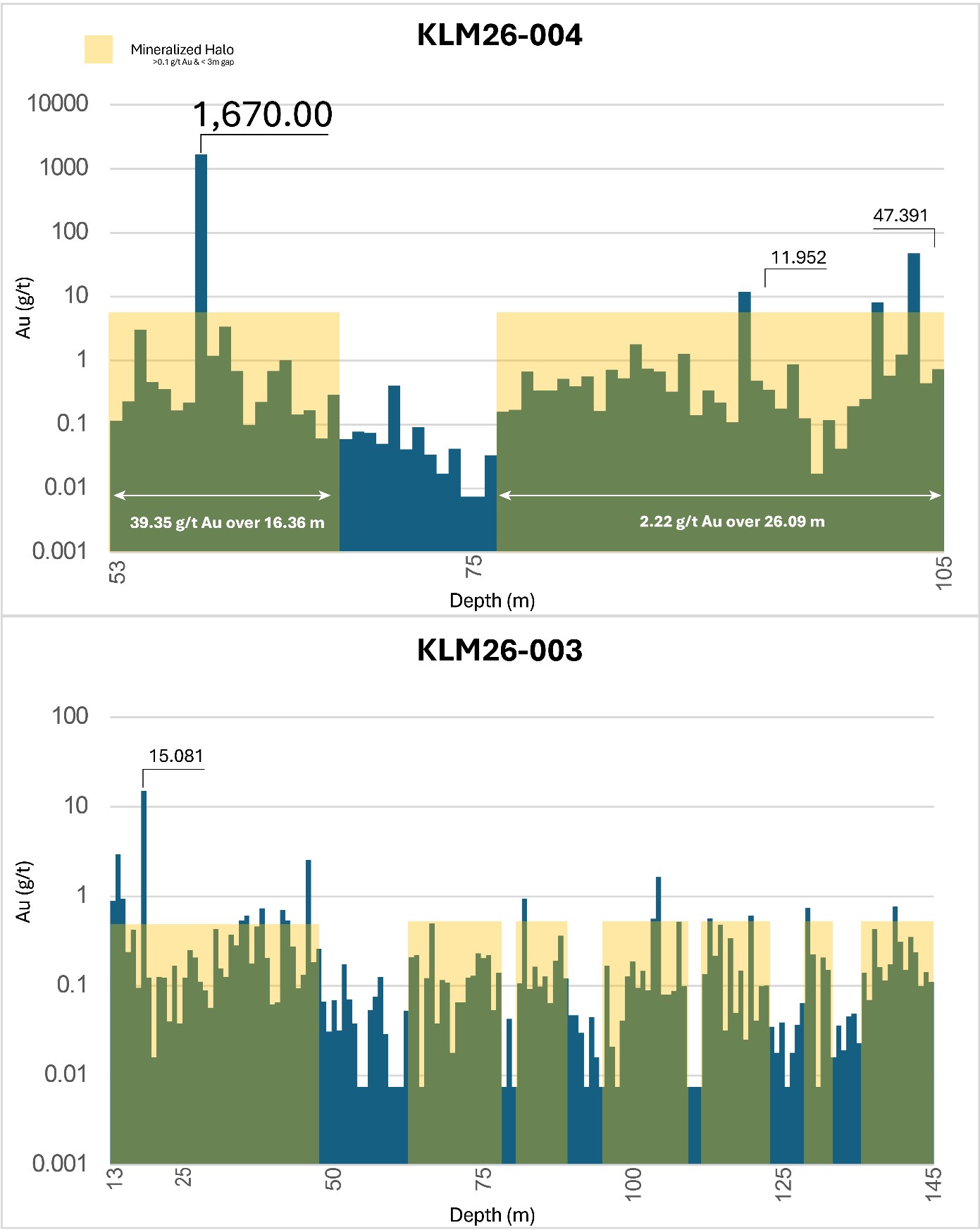
Figure 3 – Gold bearing zones in KLM26-003 and KLM26-004. Samples contained anomalous gold to a downhole depth of 145 m in KLM26-003.
To view an enhanced version of this graphic, please visit:
https://images.newsfilecorp.com/files/5701/295712_4ac166f61437c8fb_003full.jpg
Mining Hub – Interactive 3D model
Kirkland Lake Discoveries Corp. has launched a publicly accessible, interactive 3D drill hole model in partnership with Mining Hub, providing stakeholders with direct access to visualized drilling data. This initiative reflects the Company’s commitment to transparency and technical integrity, allowing investors and industry participants to independently review and better understand the geometry, continuity, and scale of mineralization across the KL South Project. This can be viewed at: https://mininghub.com/3d/v/BwihGyXn.
Progress Update and Next Steps
Drilling has been temporarily paused to accommodate seasonal spring melt conditions, which are progressing well. The Company anticipates resuming operations with two drill rigs in the coming weeks.
Results from the current program are being integrated into an evolving 3D geological model, enhancing the Company’s understanding of structural controls and mineralization trends. Ongoing drilling will focus on systematic step-out targeting along strike and at depth, while evaluating down-plunge continuity of the South Zone and testing priority geophysical targets, including the deep IP anomaly (see Figure 4). Additional drilling will also aim to increase data density in support of future resource modelling.
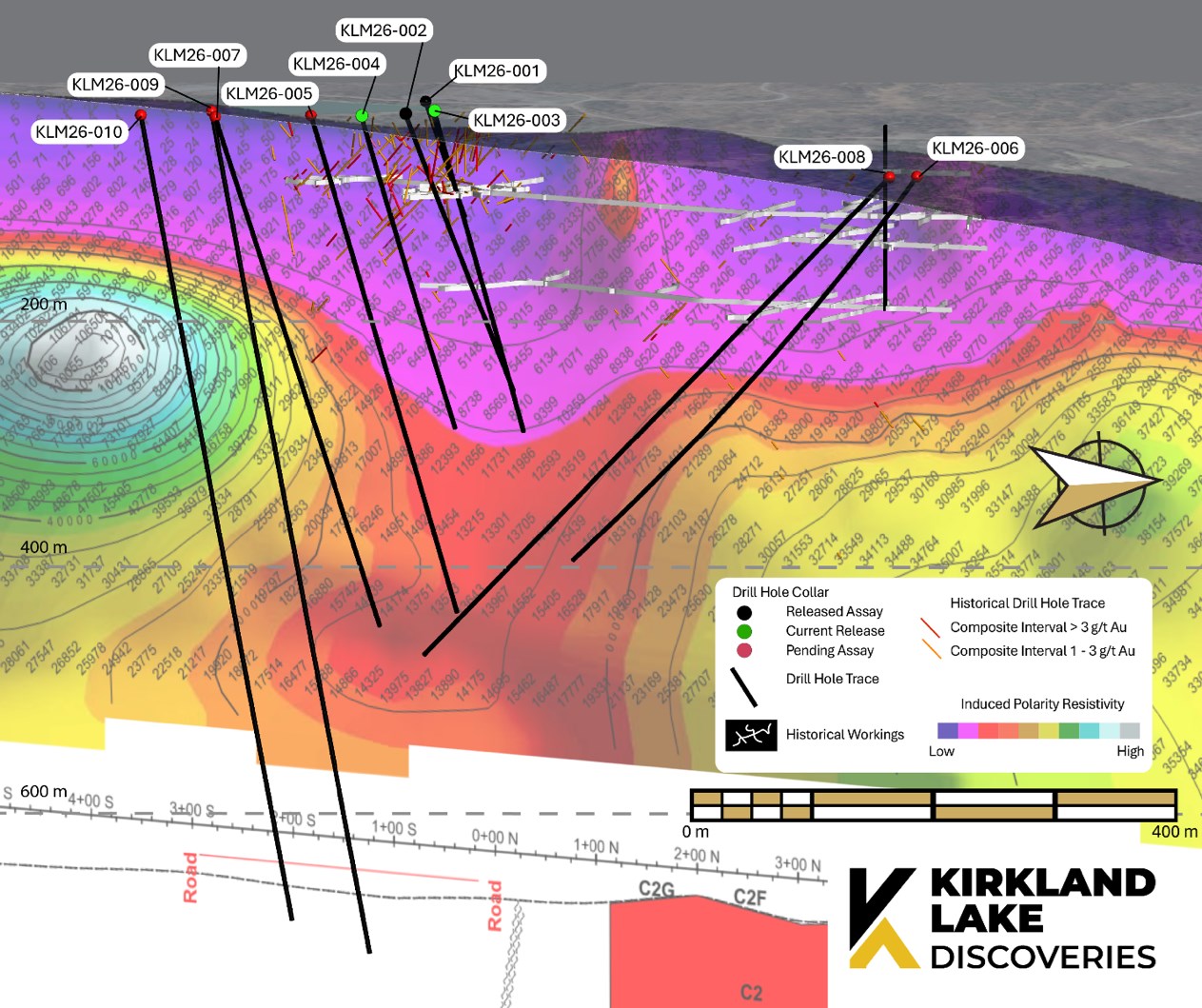
Figure 4 – 2026 drill traces and IP resistivity low anomaly beneath historical drilling looking west
To view an enhanced version of this graphic, please visit:
https://images.newsfilecorp.com/files/5701/295712_4ac166f61437c8fb_004full.jpg
To further refine targeting across the broader KL South property, the Company is planning a MobileMT geophysical survey to provide district-scale coverage and improve structural and lithological interpretation across the project area.
To support efficient assay turnaround and improve analytical reliability, KLDC has implemented Chrysos PhotonAssay™ technology through Paragon Geochemical.
Operating in a safe, mining-friendly jurisdiction with a disciplined and focused exploration program, Kirkland Lake Discoveries Corp. is advancing the Mirado Project toward a modern, well-defined gold asset within the Abitibi Greenstone Belt.
Video Footage
The latest episode of KLDC’s Treasure Hunters series on YouTube follows the ongoing journey for discovery in Kirkland Lake. Follow along with exploration with CEO Stefan Sklepowicz on site and VP Exploration Ben Cleland discussing results from our ongoing drill program at Mirado with video of the core from this release.
Cannot view this video? Visit:
https://www.youtube.com/watch?v=auW_irzISIk
Data Verification & Quality Assurance/Quality Control (QA/QC)
Gold analyses were completed on ½ NQ Core at Paragon Geochemical using Chrysos PhotonAssay™ technology, a fast, non-destructive analytical method that utilizes high-energy X-rays to directly measure gold content in large (~500 g) samples. This approach improves analytical precision and reduces the impact of coarse gold (“nugget effect”) compared to traditional fire assay methods, while also enabling faster turnaround times.
Paragon preparation and Analysis
| Analysis | Code | Locations |
| Preparation | PREP-PKG | Timmins Ontario Canada |
| Photon and Fire Assay | PA-AU01,Au-SCR1K | Surrey British Columbia Hamilton Ontario Canada |
| Multi-Element | 33MA-OES | Sparks, Nevada, USA |
Samples returning gold values above the 350 ppm upper detection limit of the PhotonAssay method are reanalyzed using a 1 kg screen fire assay, wherein the sample is sieved at 110 microns, the coarse (+) fraction is analyzed by gravimetric methods, and the fine (-) fraction is analyzed in duplicate by AAS, with the combined results providing a representative total gold value, particularly in samples containing coarse gold.
Drill program design, QA/QC, and interpretation of results were conducted by qualified persons consistent with National Instrument 43-101 and industry best practices. Certified reference standards and blanks were inserted into the sample stream at regular intervals, approximately one control sample per twenty samples, to monitor analytical accuracy and precision.
Reported intervals are calculated using a weighted average grade with a 0.2 g/t Au cutoff. To reflect the continuity of mineralization within the broader system, up to 3.0 m of internal dilution (consecutive material below cutoff) is included within reported composites. No top-cutting has been applied to high-grade results. True widths are estimated at approximately 80% of the reported core length intervals. Assays are uncut except where indicated.
Qualified Person
The technical information contained in this news release has been reviewed and approved by Benjamin Cleland, P.Geo., Vice-President Exploration, who is a Qualified Person as defined by National Instrument 43-101 – Standards of Disclosure for Mineral Projects.
About Kirkland Lake Discoveries Corp.
Kirkland Lake Discoveries Corp. (TSXV: KLDC) (OTCQB: KLKLF) has assembled a 420-km² exploration portfolio in the Kirkland Lake region of Ontario’s Abitibi Greenstone Belt, one of the most prolific mining districts in the world. The Company’s properties span key fault zones, geophysical anomalies, and volcanic-sedimentary contacts within the Blake River Group, a highly prospective assemblage known to host both gold and polymetallic massive-sulphide deposits.
With exploration permits now in place, KLDC is positioned to advance a strong pipeline of drill-ready targets at KL South, KL West and KL East, supported by multiple anomalous soil trends, historical mineral showings, and structurally controlled intersections.
For additional information, please contact:
Stefan Sklepowicz
Chief Executive Officer
Phone: +1 226-979-3515
Email: stefan@kirklandlakediscoveries.com
Website: www.kirklandlakediscoveries.com
Neither TSX Venture Exchange nor its Regulation Services Provider (as that term is defined in policies of the TSX Venture Exchange) accepts responsibility for the adequacy or accuracy of this release.
Forward-Looking Statements This news release contains “forward-looking statements” within the meaning of applicable securities legislation. All statements, other than statements of historical fact, are forward-looking statements. Forward-looking statements in this news release include, but are not limited to, statements with respect to the Company’s 2026 drilling program, the expansion of high-grade zones, the validation of historical data, and the potential for a mineral resource. Generally, forward-looking statements can be identified by the use of forward-looking terminology such as “plans”, “expects” or “does not expect”, “is expected”, “budget”, “scheduled”, “estimates”, “forecasts”, “intends”, “anticipates” or “does not anticipate”, or “believes”, or variations of such words and phrases or state that certain actions, events or results “may”, “could”, “would”, “might” or “will be taken”, “occur” or “be achieved”.
Forward-looking statements are subject to known and unknown risks, uncertainties and other factors that may cause the actual results, level of activity, performance or achievements of the Company to be materially different from those expressed or implied by such forward-looking statements, including but not limited to: the results of exploration and drilling activities; the reliability of historical data; the price of gold and other commodities; and general economic, market or business conditions. Although the Company has attempted to identify important factors that could cause actual results to differ materially from those contained in forward-looking statements, there may be other factors that cause results not to be as anticipated, estimated or intended. There can be no assurance that such statements will prove to be accurate, as actual results and future events could differ materially from those anticipated in such statements. Accordingly, readers should not place undue reliance on forward-looking statements. The Company does not undertake to update any forward-looking statements that are incorporated by reference herein, except in accordance with applicable securities laws.
| Hole | Easting | Northing | Azi (º) | Inclination (º) | Final Length (m) | Target/Showing | Assay Result Status |
| KLM26-001 | 587230 | 5318337 | 70 | -50 | 115 | Mirado SZ | Released |
| KLM26-001B | 587230 | 5318337 | 70 | -50 | 303 | Mirado SZ | Released |
| KLM26-002 | 587301 | 5318309 | 70 | -45 | 300 | Mirado SZ | Released |
| KLM26-003 | 587290 | 5318352 | 70 | -55 | 300 | Mirado SZ | Released |
| KLM26-004 | 587311 | 5318276 | 70 | -55 | 300 | Mirado SZ | Released |
| KLM26-005 | 587300 | 5318242 | 70 | -50 | 498 | Mirado SZ | Pending |
| KLM26-006 | 587687 | 5318705 | 224 | -50 | 504 | Mirado NZ | Pending |
| KLM26-007 | 587290 | 5318195 | 70 | -50 | 504 | Mirado SZ | Pending |
| KLM26-008 | 587690 | 5318682 | 210 | -45 | 573 | Mirado NZ | Pending |
| KLM26-009 | 587270 | 5318098 | 70 | -65 | 732 | Mirado SZ | Pending |
| KLM26-010 | 587256 | 5318158 | 70 | -65 | 636 | Mirado SZ | Pending |