




Vancouver, Canada and Melbourne, Australia–(Newsfile Corp. – April 9, 2026) – Southern Cross Gold Consolidated Ltd (TSX: SXGC) (ASX: SX2) (OTCQX: SXGCF) (FSE: MV3) (“SXGC”, “SX2” or the “Company”) announces that its deepest drill hole at the 100%-owned Sunday Creek Gold-Antimony Project in Victoria has intersected gold mineralization 460 metres below Golden Dyke, confirming the system persists to record depth (Figures 1 to 5).
Four High Level Takeaways:
-
Mineralization confirmed 460 m below previous intersected gold at Golden Dyke: SDDSC194W1 intersected a wide zone of 66 m of dyke and altered sediment (interpreted true width of 28 m) at approximately 1,236 m vertically below surface, with gold mineralization present including 0.9 m @ 5.4 g/t AuEq (5.4 g/t Au, 0.0% Sb) over a broader 17 m zone. The mineralizing system remains open and active at substantial depth.
-
Significantly beyond the exploration target: The hole extended approximately 490 m below the defined exploration target at Golden Dyke, materially expanding the potential depth extent of the deposit and confirming scale comparable to mineralization depths discovered at the Rising Sun prospect.
-
Fluid chemistry is right at depth: Arsenic-to-antimony ratios observed in the deep drilling are consistent with expected geochemical zonation changes, providing strong vectoring confidence that the system retains the correct fluid signature at these levels.
-
Geometric framework established for future deep drilling: The south-to-north orientation of this control program establishes a framework that allows future holes to cross the mineralized system in an east-west orientation at a high angle, optimizing future intercept geometry and enabling more efficient testing of the deposit as the Company continues to systematically expand the scale of Sunday Creek at depth.
Michael Hudson, President & CEO states: “This is a milestone hole for Sunday Creek. SDDSC194W1 was designed to answer a simple but critical question: does the system persist at depth well beyond our current exploration target? The answer is yes. In a bold step-out to untested depths, at 1,236 m below surface and 460 vertical metres below the last known mineralization at Golden Dyke, we intersected 66 m of dyke and altered sediment with gold present. This is the deepest hole on the property to date. The thesis was to test whether the host sequence continued at depth – that thesis has been emphatically proven, and that we hit gold across a 28 m true thickness zone was an absolute bonus. The width between the “rails of the ladder” are commensurate with known mineralization 500 m higher in the system.
“What gives us added confidence is the geochemistry. The arsenic-to-antimony ratios we’re seeing at depth are exactly what the epizonal model predicts, the fluid chemistry signature is right, and it tells us we are still within the productive part of the plumbing system. We are well below the antimony zone and into the sulphosalt area within the brittle-ductile transition – exactly where we expect to find robust, deep gold systems in the Victorian orogenic gold province. That’s a powerful vectoring tool as we plan the next series of holes into this area.
“This result demonstrates that at least another 50% of vertical space exists below our current drilled area of 1.5 km strike and 1 km depth. Adjacent deposits in Victoria are being tested below two km, and with erosion levels thought to be similar across all deposits, we are confident that Sunday Creek can continue beyond two km from surface. Based on the confidence of this hole, we have committed to drilling a second deep hole targeting close to two km depth (drill hole SDDSC226W1).
“In this style of mineralization, the veins form the rungs of a ladder, and drilling sub-parallel to those rungs can easily miss them entirely. The fact that we intersected a 28 m true thickness altered and veined zone with anomalous gold throughout confirms that the host sequence is thick, repeatable, and fertile at these depths. An exciting result.”
For Those Who Like the Details – Highlights:
-
Diamond drill holes SDDSC194 and its wedge SDDSC194W1 were completed deep below the Golden Dyke prospect, drilled south to north to test the mineralized system at approximately 1,236 m below surface and 460 vertical metres below the last intersected dyke and mineralization at Golden Dyke.
-
The program extended significantly beyond the current exploration target, reaching approximately 490 m below the defined exploration target at Golden Dyke. True widths are estimated at approximately 42% of reported downhole thicknesses.
-
SDDSC194 & SDDSC194W1 (south to north, control hole): Intercepted 66 m of dyke and altered sediment (interpreted true width of 28 m), confirming the mineralizing system remains open at substantial depth with gold mineralization present:
-
17.0 m @ 0.2 g/t AuEq (0.2 g/t Au, 0.0% Sb) from 1358.6 m
-
6.6 m @ 1.0 g/t AuEq (1.0 g/t Au, 0.0% Sb) from 1389.4 m, including;
-
0.9 m @ 5.4 g/t AuEq (5.4 g/t Au, 0.0% Sb) from 1392.6 m
-
-
-
Arsenic-to-antimony ratios are consistent with expected geochemical changes at depth, indicating the correct fluid chemistry signature for the system at these levels
-
The depth of mineralization is comparable to depths discovered at the Rising Sun prospect, reinforcing the interpreted scale of the Sunday Creek system
Drill Hole Discussion
SDDSC194 & SDDSC194W1
SDDSC194 and its subsequent wedge, SDDSC194W1 were designed as a deep control hole at Golden Dyke, drilled south to north, targeting the mineralized system at approximately 1,236 m below surface and 460 vertical metres below the last intersected dyke and mineralization in the Golden Dyke Prospect. This is the deepest hole completed on the property to date. The program had one clear objective: to determine whether the mineralizing system persists at depth well beyond the current exploration target.
SDDSC194W1 was required due to the original parent hole becoming stuck in a fault. The hole extended beyond previously tested limits in Golden Dyke; approximately 490 m below the defined exploration target. At these depths, the program intersected 66 m of dyke and altered sediment, (interpreted true width of 28 m), confirming the mineralizing system remains open and active at substantial depth.
The presence of gold mineralization at these depths, hosted within a broad zone of dyke and altered sediment, demonstrates the continuity and scale of the Golden Dyke system well beyond previously tested limits and materially expands the potential depth extent of the deposit. Critically, the host sequence exists at comparable thickness to intervals above, demonstrating that the system is repeatable at depth. The drill hole was oriented sub-parallel to the veins (the “rungs of the ladder”) meaning that numerous individual veins may have been missed, yet anomalous gold was present throughout the full 28 m true thickness of the intersection. The mineralized depths discovered are comparable to those seen at the Rising Sun prospect, reinforcing the interpreted scale of the broader Sunday Creek system. An additional deep hole ~450 m below the Rising Sun prospect is currently underway (drill hole SDDSC226W1).
Arsenic-to-antimony ratios observed in the deep drilling are consistent with expected geochemical changes at depth, indicating the correct fluid chemistry signature for the system at these levels and providing strong vectoring confidence for ongoing exploration. These ratios confirm the intersection sits within the sulphosalt zone, well below the antimony-dominant area and within the brittle-ductile transition. The low antimony tenor at this depth is expected within the epizonal zonation model, which predicts antimony enrichment concentrated in the upper portions of the system, with arsenic becoming the more dominant pathfinder element at depth.
The south-to-north orientation of this control program establishes a framework that allows future holes to cross the host of the mineralized system at a high angle, optimizing future intercept geometry and enabling more efficient testing of the deposit as the Company continues to systematically expand the scale of Sunday Creek at depth.
This result demonstrates that at least 50% additional vertical space exists below the current drilled area of 1.5 km strike and approximately 1 km depth. Adjacent gold deposits in Victoria are currently being tested below two km from surface, and with erosion levels considered comparable across the region, the Company is confident that mineralization at Sunday Creek can extend to equivalent depths. Based on the confidence derived from this hole, a second deep hole is currently being drilled targeting close to two km depth to further test the depth extension potential of the system.
Selected highlights include:
-
17.0 m @ 0.2 g/t AuEq (0.2 g/t Au, 0.0% Sb) from 1358.6 m
-
6.6 m @ 1.0 g/t AuEq (1.0 g/t Au, 0.0% Sb) from 1389.4 m, including;
-
0.9 m @ 5.4 g/t AuEq (5.4 g/t Au, 0.0% Sb) from 1392.6 m
-
Pending Results and Update
Nine drill rigs are currently operational on the Sunday Creek project with one additional drill rig dedicated to regional exploration. Results are pending from 49 holes currently being processed and analyzed including ten holes that are actively being drilled and one abandoned hole (Figure 3). The Company continues its ongoing 200,000 m drill program through to Q1 2027.
About Sunday Creek
The Sunday Creek epizonal-style gold project is located 60 km north of Melbourne within 16,900 hectares (“Ha”) of granted exploration tenements. SXGC is also the freehold landholder of 1,392 Ha that forms the key portion in and around the main drilled area at the Sunday Creek Project.
Gold and antimony form in a relay of vein sets that cut across a steeply dipping zone of intensely altered rocks (the “host”). These vein sets are like a “Golden Ladder” structure where the main host extends between the side rails deep into the earth, with multiple cross-cutting vein sets that host the gold forming the rungs. At Apollo and Rising Sun these individual ‘rungs’ have been defined over 600 m depth extent from surface to over 1,200 m below surface, are 2.5 m to 3.5 m wide (median widths) (and up to 10 m), and 20 m to 100 m in strike.
Cumulatively, 249 drill holes for 116,390.19 m have been reported from Sunday Creek since late 2020. This amount includes five holes for 929 m that have been drilled for geotechnical purposes and 22 holes for 2,973.77 m that were abandoned due to deviation or hole conditions. Fourteen drillholes for 2,383 m have been reported regionally outside of the main Sunday Creek drill area with three additional regional holes currently being processed. A total of 64 historic drill holes for 5,599 m were completed from the late 1960s to 2008. The project now contains a total of eighty-one (81) composite intersections exceeding 100 g/t Au and seventy-two (72) composite intersections between 50-100 g/t Au, and one-hundred and one (101) composite intersections exceeding 10% Sb by applying a 1 m (down hole length) @ 5 g/t AuEq lower cut.
Southern Cross Gold’s systematic drill program is strategically targeting these significant vein formations, which are currently defined over 1,550 m strike of the host dyke/sediment (“rails of the ladder”) from Christina to Apollo prospects, of which approximately 650 m has been more intensively drill tested (Golden Dyke to Apollo). At least 115 ‘rungs’ have been defined to date, defined by high-grade intercepts (20 g/t Au to >7,330 g/t Au) along with lower grade edges. Ongoing step-out drilling is aiming to uncover the potential extent of this mineralized system (Figure 6).
Geologically, the project is located within the Melbourne Structural Zone in the Lachlan Fold Belt. The regional host to the Sunday Creek mineralization is an interbedded turbidite sequence of siltstones and minor sandstones metamorphosed to sub-greenschist facies and folded into a set of open north-west trending folds.
Further Information
Further discussion and analysis of the Sunday Creek project is available through the interactive Vrify 3D animations, presentations and videos all available on the SXGC website. These data, along with an interview on these results with President & CEO/Managing Director Michael Hudson can be viewed at www.southerncrossgold.com.
No upper gold grade cut is applied in the averaging and intervals are reported as drill thickness. However, during future Mineral Resource studies, the requirement for assay top cutting will be assessed. The Company notes that due to rounding of assay results to one significant figure, minor variations in calculated composite grades may occur.
Figures 1 to 5 show project location, plan and longitudinal views of drill results reported here and Tables 1 to 3 provide collar and assay data. The true thickness of the mineralized intervals reported individually as estimated true widths (“ETW”), otherwise they are interpreted to be approximately 42% of the sampled thickness for other reported holes. Lower grades were cut at 0.1 g/t AuEq lower cutoff over a maximum width of 20 m with higher grades cut at 2.0 g/t AuEq lower cutoff over a maximum of 1 m width.
Critical Metal Epizonal Gold-Antimony Deposits
Sunday Creek (Figure 6) is an epizonal gold-antimony deposit formed in the late Devonian (like Fosterville, Costerfield and Redcastle), 60 million years later than mesozonal gold systems formed in Victoria (for example Ballarat and Bendigo). Epizonal deposits are a form of orogenic gold deposit classified according to their depth of formation: epizonal (<6 km), mesozonal (6 km to 12 km) and hypozonal (>12 km).
Epizonal deposits in Victoria often have associated high levels of the critical metal, antimony, and Sunday Creek is no exception. China claims a 56 per cent share of global mined supplies of antimony, according to a 2023 European Union study. Antimony features highly on the critical minerals lists of many countries including Australia, the United States of America, Canada, Japan and the European Union. Australia ranks seventh for antimony production despite all production coming from a single mine at Costerfield in Victoria, located nearby to all SXGC projects. Antimony alloys with lead and tin which results in improved properties for solders, munitions, bearings and batteries. Antimony is a prominent additive for halogen-containing flame retardants. Adequate supplies of antimony are critical to the world’s energy transition, and to the high-tech industry, especially the semi-conductor and defence sectors where it is a critical additive to primers in munitions.
Antimony represents approximately 21% to 24% in situ recoverable value of Sunday Creek at an AuEq of 2.39 ratio.
About Southern Cross Gold Consolidated Limited (TSX: SXGC) (ASX: SX2) (OTCQX: SXGCF) (FSE: MV3)
Southern Cross Gold Consolidated Ltd. (TSX: SXGC) (ASX: SX2) (OTCQX: SXGCF), is defining a leading gold-antimony project at the Sunday Creek Gold-Antimony Project, located 60 km north of Melbourne. Sunday Creek is a significant gold and antimony drill discovery in a Tier 1 location, with high-grade drill results including 81 composite intersections exceeding 100 g/t Au from 114.8 km of drilling. The mineralization follows a “Golden Ladder” structure over 12 km of strike length, with structures tested from surface to 1,100 m depth.
Sunday Creek’s strategic value is enhanced by its dual-metal profile. The Company has a critical mineral the Western world needs. This has gained increased significance following China’s export restrictions on antimony, a critical metal for defence and semiconductor applications. Southern Cross’ inclusion in the US Defense Industrial Base Consortium (DIBC) and Australia’s AUKUS-related legislative changes position it as a potential key Western antimony supplier.
Technical fundamentals further strengthen the investment case, with preliminary metallurgical work showing non-refractory mineralization suitable for conventional processing and gold recoveries of 93% to 98% through gravity and flotation.
With a strong cash position, 1,392 Ha of strategic freehold land ownership, and a large 200 km drill program planned through Q1 2027, SXGC is well-positioned to advance this globally significant gold-antimony discovery in a tier-one jurisdiction, delivering milestone by milestone.
– Ends –
For ASX Compliance: This announcement has been approved for release by the Board of Southern Cross Gold Consolidated Ltd.
For further information, please contact:
Mariana Bermudez – Corporate Secretary
mb@southerncrossgold.com or +1 604 685 9316
Executive Office
1305 – 1090 West Georgia Street Vancouver, BC, V6E 3V7, Canada
Nicholas Mead – Corporate Development
info@southerncrossgold.com.au or +61 415 153 122
Justin Mouchacca, Assistant Company Secretary,
jm@southerncrossgold.com.au or +61 3 8630 3321
Subsidiary Office
Level 21, 459 Collins Street, Melbourne, VIC, 3000, Australia
NI 43-101 Technical Background and Qualified Person
Michael Hudson, President, CEO and Managing Director of SXGC, and a Fellow of the Australasian Institute of Mining and Metallurgy, is the Qualified Person as defined by the NI 43-101. They have prepared, reviewed, verified and approved the technical contents of this release.
Analytical samples are transported to the Bendigo facility of On Site Laboratory Services (“On Site”) which operates under both an ISO 9001 and NATA quality systems. Samples were prepared and analyzed for gold using the fire assay technique (PE01S method; 25 gram charge), followed by measuring the gold in solution with flame AAS equipment. Samples for multi-element analysis (BM011 and over-range methods as required) use aqua regia digestion and ICP-MS analysis. The QA/QC program of Southern Cross Gold consists of the systematic insertion of certified standards of known gold content, blanks within interpreted mineralized rock and quarter core duplicates. In addition, On Site inserts blanks and standards into the analytical process.
SXGC considers that both gold and antimony that are included in the gold equivalent calculation (“AuEq”) have reasonable potential to be recovered and sold at Sunday Creek, given current geochemical understanding, historic production statistics and geologically analogous mining operations. Historically, ore from Sunday Creek was treated onsite or shipped to the Costerfield mine, located 54 km to the northwest of the project, for processing during WW1. The Costerfield mine corridor, now owned by Alkane Resources (previously Mandalay Resources) contains two million ounces of equivalent gold (Mandalay Resources Q3 2021 Results), and in 2020 was the sixth highest-grade global underground mine and a top 5 global producer of antimony.
SXGC considers that it is appropriate to adopt the same gold equivalent variables as Mandalay Resources Ltd in its 2024 End of Year Mineral Reserves and Resources Press Release, dated February 20, 2025. The gold equivalence formula used by Mandalay Resources was calculated using Costerfield’s 2024 production costs, using a gold price of US$2,500 per ounce, an antimony price of US$19,000 per tonne and 2024 total year metal recoveries of 91% for gold and 92% for antimony, and is as follows:
AuEq = Au (g/t) + 2.39 x Sb (%)
Based on the latest Costerfield calculation and given the similar geological styles and historic toll treatment of Sunday Creek mineralization at Costerfield, SXGC considers that a AuEq = Au (g/t) + 2.39 x Sb (%) is appropriate to use for the initial exploration targeting of gold-antimony mineralization at Sunday Creek.
JORC Competent Person Statement
Information in this announcement that relates to new exploration results contained in this report is based on information compiled by Mr Kenneth Bush and Mr Michael Hudson. Mr Bush is a Member of Australian Institute of Geoscientists and a Registered Professional Geologist in the field of Mining (#10315) and Mr Hudson is a Fellow of The Australasian Institute of Mining and Metallurgy. Mr Bush and Mr Hudson each have sufficient experience relevant to the style of mineralization and type of deposit under consideration, and to the activities undertaken, to qualify as a Competent Person as defined in the 2012 Edition of the Joint Ore Reserves Committee (JORC) Australasian Code for Reporting of Exploration Results, Mineral Resources and Ore Reserves. Mr Bush is Head of Exploration and Mr Hudson is President, CEO and Managing Director of Southern Cross Gold Consolidated Limited and both consent to the inclusion in the report of the matters based on their information in the form and context in which it appears.
Certain information in this announcement that relates to prior exploration results is extracted from the Independent Geologist’s Report dated 11 December 2024 which was issued with the consent of the Competent Person, Mr Steven Tambanis. The report is included the Company’s prospectus dated 11 December 2024 and is available at www.asx.com.au under code “SX2”. The Company confirms that it is not aware of any new information or data that materially affects the information related to exploration results included in the original market announcement. The Company confirms that the form and context of the Competent Persons’ findings in relation to the report have not been materially modified from the original market announcement.
Certain information in this announcement also relates to prior drill hole exploration results, are extracted from the following announcements, which are available to view on www.southerncrossgold.com:
- 4 October, 2022 SDDSC046, 20 October, 2022 SDDSC049, 5 September, 2023 SDDSC077B, 12 October, 2023 SDDLV003 & 4, 23 October, 2023 SDDSC082, 9 November, 2023 SDDSC091, 14 December, 2023 SDDSC092, 5 March, 2024 SDDSC107, 30 May, 2024 SDDSC117, 13 June, 2024 SDDSC118, 5 September, 2024 SDDSC130, 28 October, 2024 SDDSC137W2, 28 November, 2024 SDDSC141, 9 December, 2024 SDDSC145, 18 December, 2024 SDDSC129 & 144, 28 May, 2025 SDDSC161, 16 June, 2025 SDDSC162, 26 August, 2025 SDDSC171, 8 September, 2025 SDDSC170A,
The Company confirms that it is not aware of any new information or data that materially affects the information included in the original document/announcement and the Company confirms that the form and context in which the Competent Person’s findings are presented have not materially modified from the original market announcement.
Forward-Looking Statement
This news release contains forward-looking statements. Forward-looking statements involve known and unknown risks, uncertainties and assumptions and accordingly, actual results and future events could differ materially from those expressed or implied in such statements. You are hence cautioned not to place undue reliance on forward-looking statements. All statements other than statements of present or historical fact are forward-looking statements. Forward-looking statements include words or expressions such as “proposed”, “will”, “subject to”, “near future”, “in the event”, “would”, “expect”, “prepared to” and other similar words or expressions. Factors that could cause future results or events to differ materially from current expectations expressed or implied by the forward-looking statements include general business, economic, competitive, political, social uncertainties; the state of capital markets, unforeseen events, developments, or factors causing any of the expectations, assumptions, and other factors ultimately being inaccurate or irrelevant; and other risks described in the Company’s documents filed with Canadian or Australian (under code SX2) securities regulatory authorities. You can find further information with respect to these and other risks in filings made by the Company with the securities regulatory authorities in Canada or Australia (under code SX2), as applicable, and available for the Company in Canada at www.sedarplus.ca or in Australia at www.asx.com.au (under code SX2). Documents are also available at www.southerncrossgold.com The Company disclaims any obligation to update or revise these forward-looking statements, except as required by applicable law.
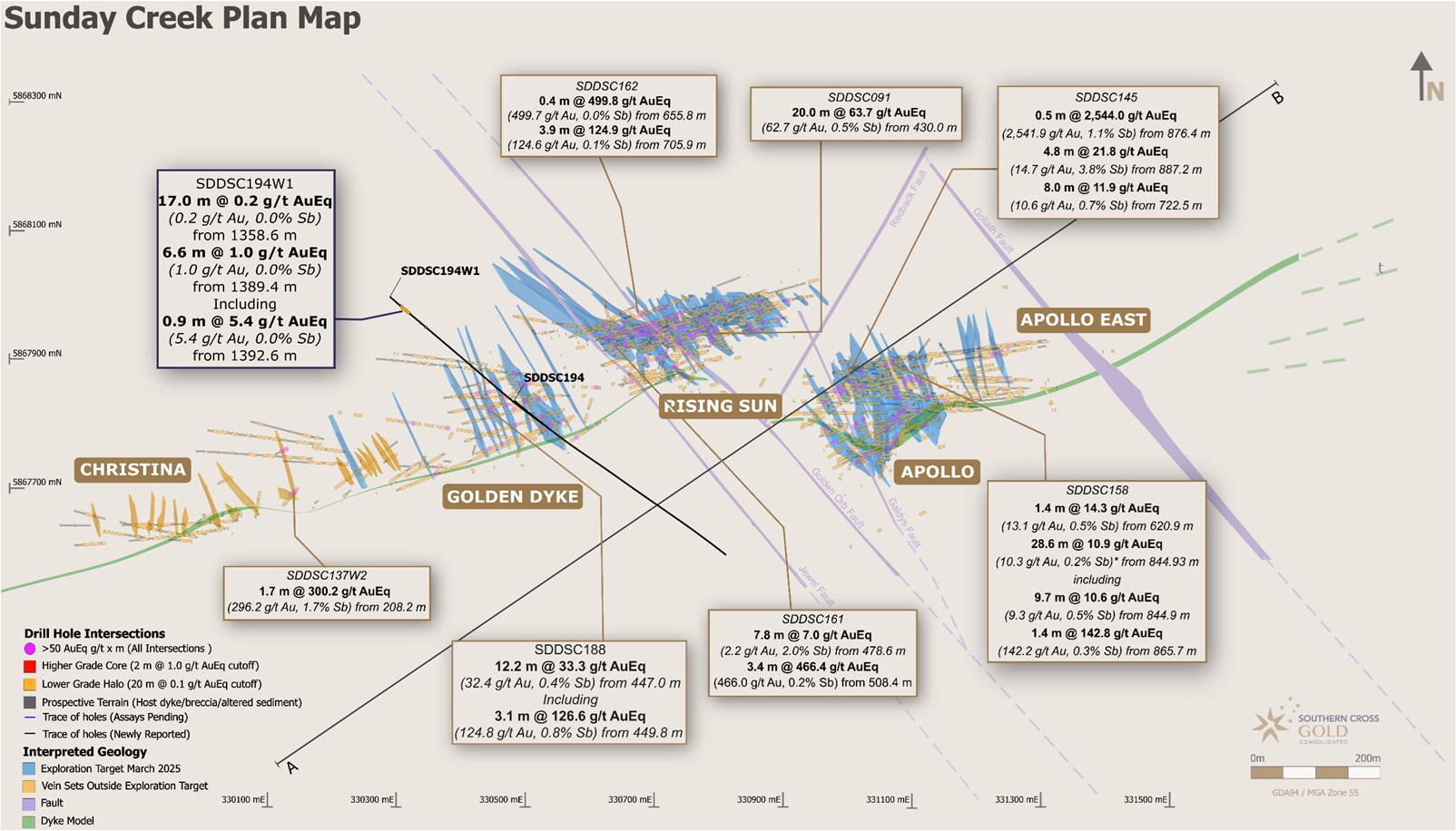
Figure 1: Sunday Creek plan view showing selected results from holes SDDSC194 and SDDSC194W1 reported here (dark blue highlighted box, black trace), with selected prior reported drill holes.
To view an enhanced version of this graphic, please visit:
https://images.newsfilecorp.com/files/11541/291721_15c311b024f17a96_001full.jpg
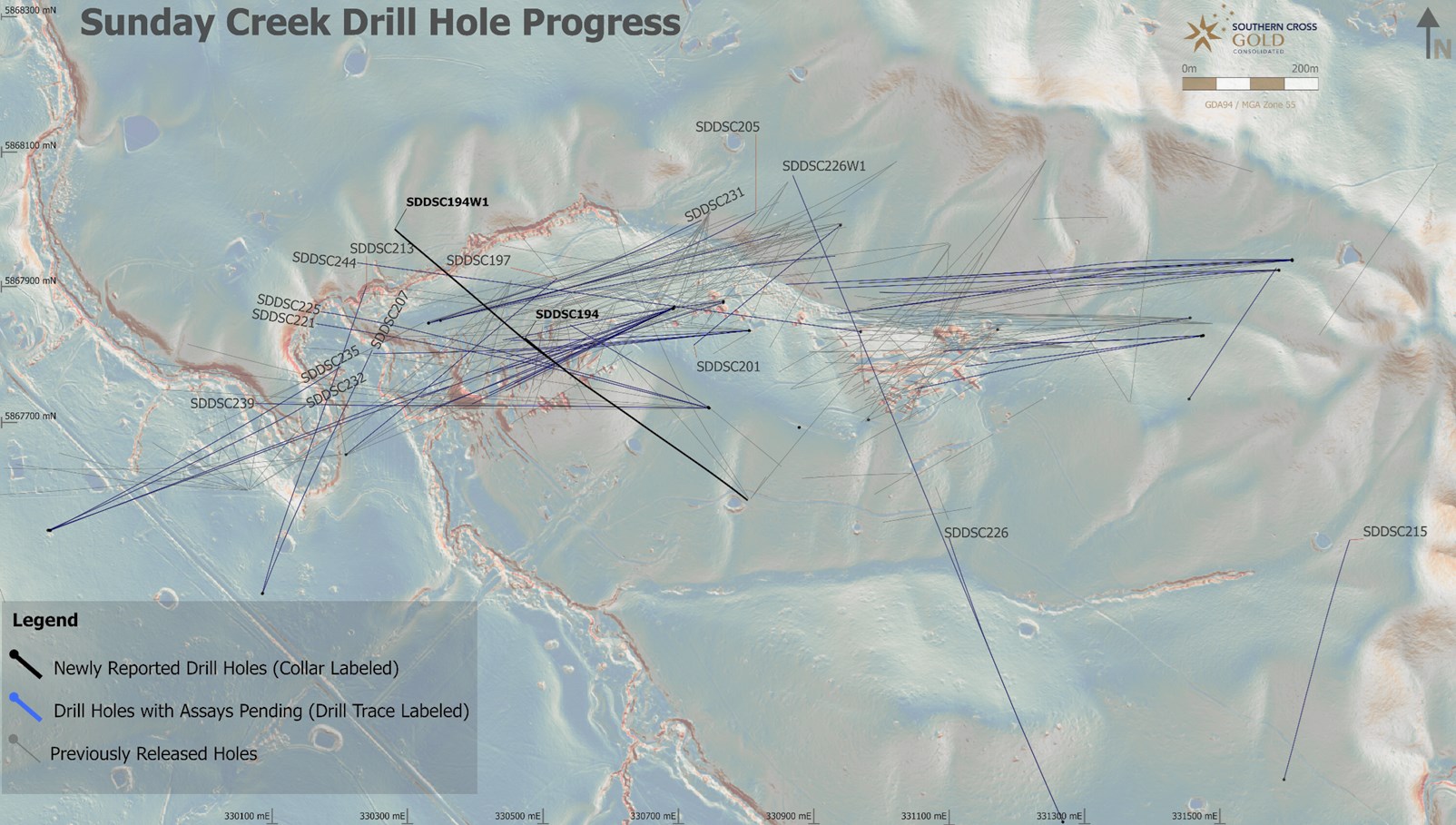
Figure 2: Sunday Creek plan view showing selected drillhole traces from holes SDDSC194 and SDDSC194W1 reported here (black trace), with prior reported drill holes (grey trace) and currently drilling and assays pending hole traces (dark blue).
To view an enhanced version of this graphic, please visit:
https://images.newsfilecorp.com/files/11541/291721_15c311b024f17a96_002full.jpg
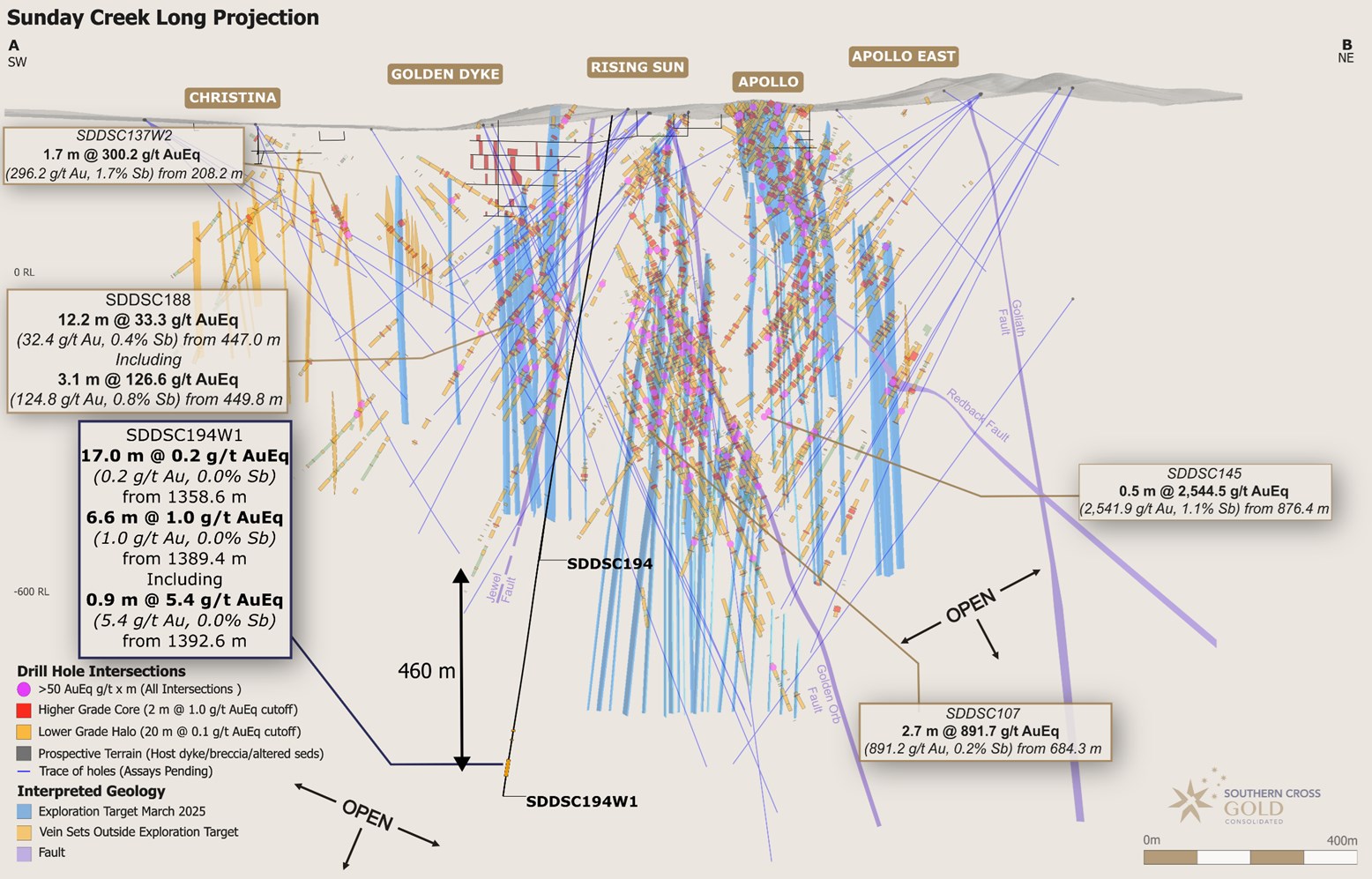
Figure 3: Sunday Creek longitudinal section across A-B in the plane of the dyke breccia/altered sediment host looking towards the NW (striking 56 degrees) indicating mineralized vein sets. Showing holes SDDSC194 and SDDSC194W1 reported here (dark blue highlighted box, black trace), with selected intersections and prior reported drill holes. The vertical extents of the vein sets are limited by proximity to drill hole pierce points.
To view an enhanced version of this graphic, please visit:
https://images.newsfilecorp.com/files/11541/291721_15c311b024f17a96_003full.jpg
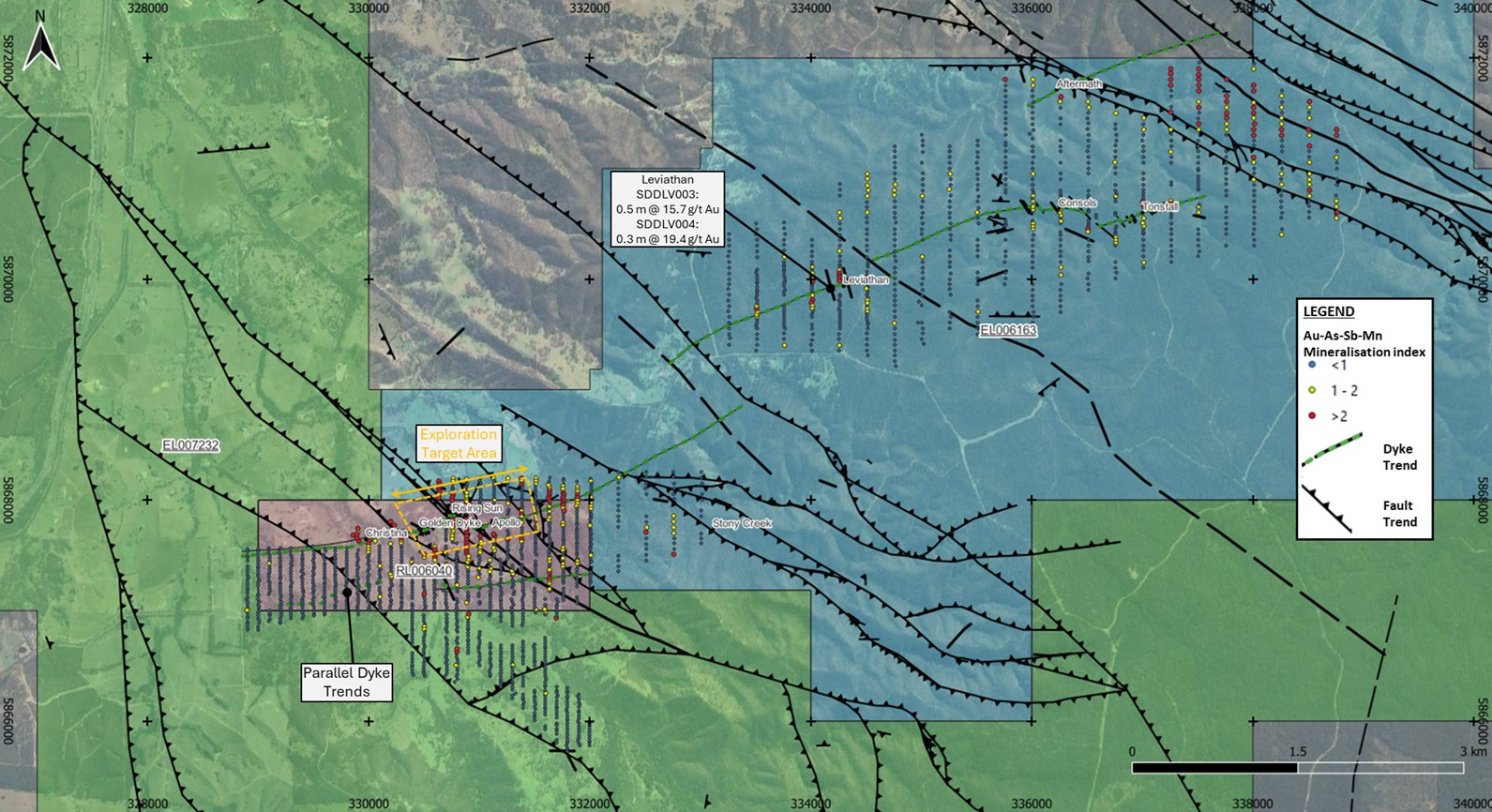
Figure 4: Sunday Creek regional plan view showing soil sampling, structural framework, regional historic epizonal gold mining areas and broad regional areas tested by 12 holes for 2,383 m drill program. The regional drill areas are at Tonstal, Consols and Leviathan located 4,000-7,500 m along strike from the main drill area at Golden Dyke- Apollo. Map in GDA94/ MGA Zone 55.
To view an enhanced version of this graphic, please visit:
https://images.newsfilecorp.com/files/11541/291721_15c311b024f17a96_004full.jpg
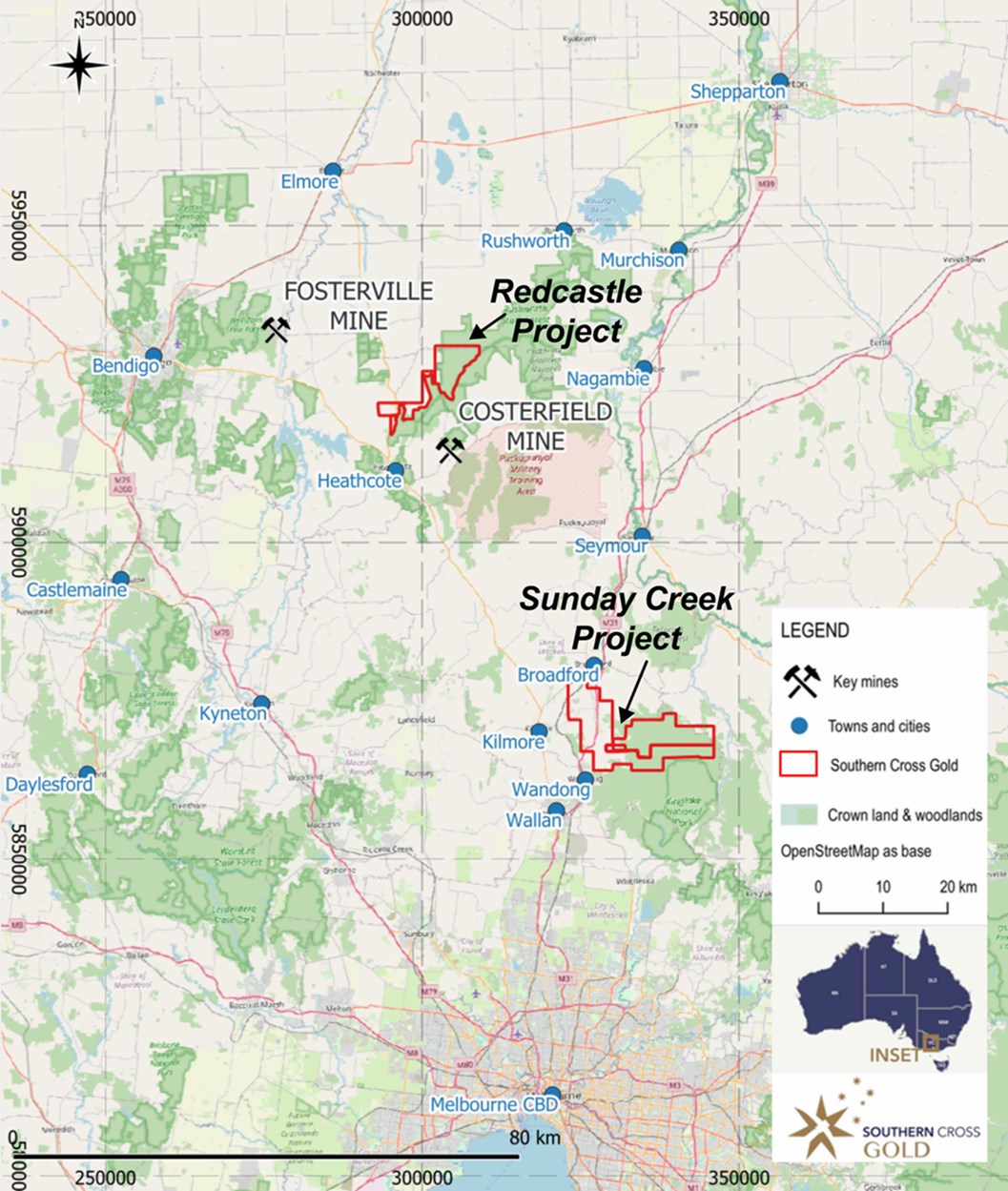
Figure 5: Location of the Sunday Creek project, along with the 100% owned Redcastle Gold-Antimony Project
To view an enhanced version of this graphic, please visit:
https://images.newsfilecorp.com/files/11541/291721_15c311b024f17a96_005full.jpg
Table 1: Drill collar summary table for recent drill holes in progress.
| This Release | ||||||||
| Hole ID | Depth (m) | Prospect | East GDA94 Z55 |
North GDA94 Z55 |
Elevation (m) |
Dip | Azimuth GDA94 Z55 |
|
| SDDSC194 | 929 | Golden Dyke | 330811.4 | 5867596.4 | 295.1 | -64.4 | 310 | |
| SDDSC194W1 | 1438.86 | Golden Dyke | 330811.4 | 5867596.4 | 295.1 | -64.4 | 311.2 | |
| Currently being processed and analyzed | ||||||||
| Hole ID | Depth (m) | Prospect | East GDA94 Z55 |
North GDA94 Z55 |
Elevation (m) |
Dip | Azimuth GDA94 Z55 |
|
| SDDSC193 | 668.1 | Golden Dyke | 330775.4 | 5867891 | 295.5 | -58.6 | 262.2 | |
| SDDSC197 | 791.5 | Golden Dyke | 330217.8 | 5867664.2 | 268.9 | -58.7 | 50.8 | |
| SDDSC201 | 321.4 | Rising Sun | 330948.3 | 5868003.4 | 313.3 | -28.9 | 231.3 | |
| SDDSC202 | 947.76 | Apollo | 331596.2 | 5867936.6 | 345.6 | -43.4 | 266.9 | |
| SDDSC203 | 547 | Golden Dyke | 330775.3 | 5867888.9 | 295.5 | -47.5 | 253.4 | |
| SDDSC204 | 1208.3 | Apollo | 331615.6 | 5867952.4 | 346.5 | -58.2 | 270.4 | |
| SDDSC205 | 1211.4 | Rising Sun | 330339.8 | 5867858.5 | 276.8 | -64.6 | 75.8 | |
| SDDSC206 | 286.2 | Golden Dyke | 330752.7 | 5867734.4 | 306.9 | -33 | 301 | |
| SDDSC207 | 584.25 | Christina | 330094.8 | 5867459.3 | 278.3 | -48.8 | 20.7 | |
| SDDSC209 | 271.58 | Apollo East | 331463.3 | 5867746.4 | 341.2 | -30.5 | 34 | |
| SDDSC210 | 512 | Golden Dyke | 330813.6 | 5867847.5 | 301.1 | -43.6 | 264.3 | |
| SDDSC211 | 380.02 | Golden Dyke | 330700.3 | 5867880.2 | 299.4 | -40.1 | 250.4 | |
| SDDSC212 | 438.7 | Apollo East | 331464.9 | 5867866.4 | 333.2 | -33.2 | 261.3 | |
| SDDSC213 | 941.4 | Golden Dyke | 330094.2 | 5867458.6 | 278.3 | -62.6 | 14.6 | |
| SDDSC214 | 431.6 | Apollo | 331615.6 | 5867951.1 | 346.94 | -55.2 | 268.9 | |
| SDDSC214W1 | In Progress plan 1150 m | Apollo | 331615.6 | 5867951.1 | 346.94 | -55.2 | 268.9 | |
| SDDSC215 | 476.39 | Regional | 331603.6 | 5867183.7 | 304.9 | -38.2 | 15.4 | |
| SDDSC216A | 572.36 | Golden Dyke | 330701.2 | 5867880.5 | 299.6 | -46.1 | 250.6 | |
| SDDSC217 | 490.7 | Apollo East | 331481.2 | 5867839.5 | 335.4 | -25 | 261.9 | |
| SDDSC218 | 796.99 | Golden Dyke | 330813.6 | 5867847.5 | 301.1 | -47.6 | 265.5 | |
| SDDSC219 | 392.2 | Golden Dyke | 330701.5 | 5867880.3 | 299.6 | -49.2 | 247.8 | |
| SDDSC220 | 716.7 | Christina | 329779.1 | 5867552.6 | 286.59 | -26.5 | 70.5 | |
| SDDSC221 | 926.54 | Golden Dyke | 330754.1 | 5867733 | 307 | -50.6 | 285.3 | |
| SDDSC222 | In Progress plan 1000 m | Apollo | 331596.1 | 5867936.9 | 345.43 | -51.5 | 267.7 | |
| SDDSC223 | 435.25 | Apollo East | 331483 | 5867839.8 | 335.72 | -33.9 | 262.2 | |
| SDDSC224 | 496.9 | Golden Dyke | 330700.6 | 5867879.9 | 299.62 | -36.8 | 246.6 | |
| SDDSC225 | 992.8 | Golden Dyke | 330754.5 | 5867733 | 306.93 | -52.8 | 284.8 | |
| SDDSC226 | 826.1 | Rising Sun | 331276.9 | 5867121.1 | 289.09 | -56.4 | 336.5 | |
| SDDSC226W1 | In Progress plan 1900 m | Rising Sun | 331276.9 | 5867121.1 | 289.09 | -56.4 | 336.5 | |
| SDDSC227 | 414.09 | Apollo East | 331483.8 | 5867840.3 | 335.83 | -36.6 | 266.5 | |
| SDDSC228 | 447.5 | Golden Dyke | 330700.9 | 5867880.2 | 299.48 | -47.1 | 245.2 | |
| SDDSC229 | 541.8 | Golden Dyke | 330813.6 | 5867847.5 | 301.1 | -48.5 | 266.9 | |
| SDDSC230 | In Progress plan 1420 m | Rising Sun | 330357.5 | 5867862.3 | 277.3 | -65.2 | 76.9 | |
| SDDSC231 | In Progress plan 1280 m | Rising Sun | 330339.8 | 5867858.5 | 276.8 | -70.1 | 71.3 | |
| SDDSC232 | 516.5 | Christina | 329777.6 | 5867552.2 | 286.76 | -34.1 | 65.7 | |
| SDDSC233 | 445.9 | Golden Dyke | 330700.8 | 5867880.1 | 299.55 | -40.7 | 245 | |
| SDDSC234 | 449 | Apollo East | 331484.5 | 5867840.3 | 335.75 | -46.1 | 266.1 | |
| SDDSC235 | In Progress plan 720 m | Christina | 329780.9 | 5867551.9 | 286.5 | -44.5 | 63.2 | |
| SDDSC236 | In Progress plan 645 m | Golden Dyke | 330813.6 | 5867847.5 | 301.1 | -49.4 | 263.6 | |
| SDDSC237 | 359 | Golden Dyke | 330700.4 | 5867880.1 | 299.67 | -43.2 | 245.7 | |
| SDDSC237W1 | In Progress plan 510 m | Golden Dyke | 330700.4 | 5867880.1 | 299.67 | -43.2 | 299.7 | |
| SDDSC239 | In Progress plan 800 m | Golden Dyke | 330754.1 | 5867733 | 306.9 | -30.9 | 270.1 | |
| Regional holes currently being processed and analyzed | ||||||||
| Hole ID | Depth (m) | Prospect | East GDA94 Z55 |
North GDA94 Z55 |
Elevation (m) |
Dip | Azimuth GDA94 Z55 |
|
| SDDRE016 | 410.45 | Redcastle | 302735 | 5927298 | 217 | -50.3 | 67.7 | |
| SDDRE017 | 359.8 | Beautiful Venus | 305388.6 | 5926618 | 206.62 | -50.9 | 68.9 | |
| SDDTS009 | 506 | Tonstal | 336992 | 5870553 | 524.6 | -28.3 | 285 | |
| SDDTS008 | 511.4 | Tonstal | 336992 | 5870553 | 524.6 | -35 | 30.2 | |
| SDDTS010 | 535.8 | Tonstal | 336992 | 5870553 | 524.6 | -37 | 44.4 | |
| SDDTS011 | In Progress plan 360 m | Tonstal | 336992 | 5870553 | 524.6 | -43 | 18 | |
| Abandoned Drillholes currently being processed and analyzed | ||||||||
| Hole ID | Depth (m) | Prospect | East GDA94 Z55 |
North GDA94 Z55 |
Elevation (m) |
Dip | Azimuth GDA94 Z55 |
|
| SDDSC216 | 131.2 | Golden Dyke | 330701 | 5867880.5 | 299.42 | -46.3 | 252.5 | |
Table 2: Table of mineralized drill hole intersections reported from SDDSC194 and SDDSC194W1 with two cutoff criteria. Lower grades cut at 0.1 g/t AuEq lower cutoff over a maximum of 20 m with higher grades cut at 1.0 g/t AuEq cutoff over a maximum of 2 m. Significant intersections and interval depths are rounded to one decimal place.
| Hole number | From (m) | To (m) | Interval (m) | Au g/t | Sb % | AuEq g/t |
| SDDSC194W1 | 1358.60 | 1375.62 | 17.02 | 0.2 | 0.0 | 0.2 |
| SDDSC194W1 | 1389.40 | 1396.00 | 6.60 | 1.0 | 0.0 | 1.0 |
| Including | 1392.60 | 1393.47 | 0.87 | 5.4 | 0.0 | 5.4 |
Table 3: All individual assays reported from SDDSC194 and SDDSC194W1 reported here >0.1g/t AuEq. Individual assay and sample intervals are reported to two decimal places.
| Hole number | From (m) | To (m) | Interval (m) | Au g/t | Sb % | AuEq g/t |
| SDDSC194W1 | 1241.3 | 1242.19 | 0.89 | 0.16 | 0.00 | 0.16 |
| SDDSC194W1 | 1244.82 | 1245.18 | 0.36 | 0.35 | 0.00 | 0.35 |
| SDDSC194W1 | 1296.41 | 1297.04 | 0.63 | 0.20 | 0.00 | 0.21 |
| SDDSC194W1 | 1297.04 | 1297.56 | 0.52 | 0.20 | 0.00 | 0.21 |
| SDDSC194W1 | 1315 | 1316 | 1.00 | 0.79 | 0.00 | 0.79 |
| SDDSC194W1 | 1316.23 | 1317.18 | 0.95 | 0.11 | 0.00 | 0.11 |
| SDDSC194W1 | 1345.12 | 1345.58 | 0.46 | 0.40 | 0.00 | 0.40 |
| SDDSC194W1 | 1358.8 | 1360 | 1.20 | 0.13 | 0.00 | 0.14 |
| SDDSC194W1 | 1360 | 1360.69 | 0.69 | 0.16 | 0.00 | 0.17 |
| SDDSC194W1 | 1360.69 | 1361.75 | 1.06 | 0.20 | 0.00 | 0.20 |
| SDDSC194W1 | 1363.77 | 1365 | 1.23 | 0.08 | 0.00 | 0.09 |
| SDDSC194W1 | 1365 | 1366 | 1.00 | 0.14 | 0.00 | 0.14 |
| SDDSC194W1 | 1366 | 1367.3 | 1.30 | 0.93 | 0.00 | 0.94 |
| SDDSC194W1 | 1367.3 | 1367.9 | 0.60 | 0.23 | 0.00 | 0.23 |
| SDDSC194W1 | 1367.9 | 1369.2 | 1.30 | 0.14 | 0.00 | 0.14 |
| SDDSC194W1 | 1369.2 | 1370.4 | 1.20 | 0.29 | 0.00 | 0.30 |
| SDDSC194W1 | 1370.4 | 1371.4 | 1.00 | 0.20 | 0.00 | 0.20 |
| SDDSC194W1 | 1371.4 | 1371.94 | 0.54 | 1.36 | 0.00 | 1.36 |
| SDDSC194W1 | 1371.94 | 1372.9 | 0.96 | 0.12 | 0.00 | 0.12 |
| SDDSC194W1 | 1389.4 | 1390.7 | 1.30 | 0.22 | 0.00 | 0.22 |
| SDDSC194W1 | 1390.7 | 1392 | 1.30 | 0.24 | 0.00 | 0.24 |
| SDDSC194W1 | 1392 | 1392.6 | 0.60 | 0.20 | 0.00 | 0.20 |
| SDDSC194W1 | 1392.6 | 1393.47 | 0.87 | 5.44 | 0.00 | 5.45 |
| SDDSC194W1 | 1393.47 | 1394.7 | 1.23 | 0.33 | 0.00 | 0.33 |
| SDDSC194W1 | 1394.7 | 1396 | 1.30 | 0.37 | 0.00 | 0.37 |
JORC Table 1
Section 1 Sampling Techniques and Data
| Criteria | JORC Code explanation | Commentary |
| Sampling techniques |
|
|
| Drilling techniques |
|
|
| Drill sample recovery |
|
|
| Logging |
|
|
| Sub-sampling techniques and sample preparation |
|
|
| Quality of assay data and laboratory tests |
|
|
| Verification of sampling and assaying |
|
|
| Location of data points |
|
|
| Data spacing and distribution |
|
|
| Orientation of data in relation to geological structure |
|
|
| Sample security |
|
|
| Audits or reviews |
|
|
Section 2 Reporting of Exploration Results
| Criteria | JORC Code explanation | Commentary |
| Mineral tenement and land tenure status |
|
|
| Exploration done by other parties |
|
|
| Geology |
|
|
| Drill hole Information |
|
|
| Data aggregation methods |
|
|
| Relationship between mineralization widths and intercept lengths |
|
|
| Diagrams |
|
|
| Balanced reporting |
|
|
| Other substantive exploration data |
|
|
| Further work |
|
|