




Toronto, Ontario–(Newsfile Corp. – July 16, 2026) – Montero Mining and Exploration Ltd. (TSXV: MON) (OTC Pink: MXTRF) (FSE: ES0) (“Montero” or the “Company“) is pleased to announce that drillhole MON-ELV-02 has been completed to a final depth of 625.25 metres at the Elvira Gold Project in northern Chile.
MON-ELV-02 is the successful redrill of the original MON-ELV-01 target and represents the first completed hole of Montero’s 2026 drill programme. The hole tested Montero’s high-priority integrated exploration targets, defined through geological, geochemical, and geophysical interpretation, including geochemical vectoring work and Artificial Intelligence (“AI”) and machine-learning-assisted data integration.
Preliminary core observations confirm the predicted volcanic sequence overlying a dacite porphyry intrusion and an extensive pyrite-bearing high-sulphidation alteration system. Geological logging and core sampling are continuing, and initial samples have been submitted to AAA Laboratory for analysis. Results will be reported once received, reviewed, and verified. Drilling of the next hole, MON-ELV-03, has now commenced.
Preliminary Geological Highlights
Preliminary geological observations review of the drill core indicates that MON-ELV-02:
- Intersected strongly altered volcanic rocks from surface to 194.9 metres.
- Intersected a feldspar-quartz-amphibole porphyry from 194.9 metres to the end of the hole.
- Confirmed the interpreted volcanic-porphyry contact at approximately 195 metres.
- Intersected widespread quartz-alunite-pyrite alteration.
- Intersected extensive disseminated and vein-hosted pyrite throughout much of the porphyry.
- Identified the base of oxidation at approximately 253 metres, below which sulphides are better preserved.
- Intersected local vuggy silica, quartz-pyrite-alunite veinlets, chalcedonic veins, and hydrothermal crackle breccias.
- Recorded trace chalcopyrite and other possible sulphide phases requiring laboratory confirmation.
The porphyry interval extends for more than 430 metres downhole and contains moderate to locally strong disseminated pyrite, coarser pyrite aggregates, and thin quartz-pyrite veinlets.
Dr. Tony Harwood, President and Chief Executive Officer of Montero, commented: “MON-ELV-02 has successfully tested our highest-priority exploration target and provided encouraging support for our integrated exploration model at Elvira. The drillhole intersected the predicted volcanic sequence, underlying porphyry and an extensive high-sulphidation alteration system with widespread pyrite corresponding to the interpreted IP chargeability anomaly. Laboratory assays will determine whether these geological features are associated with gold, silver, or copper mineralisation.”
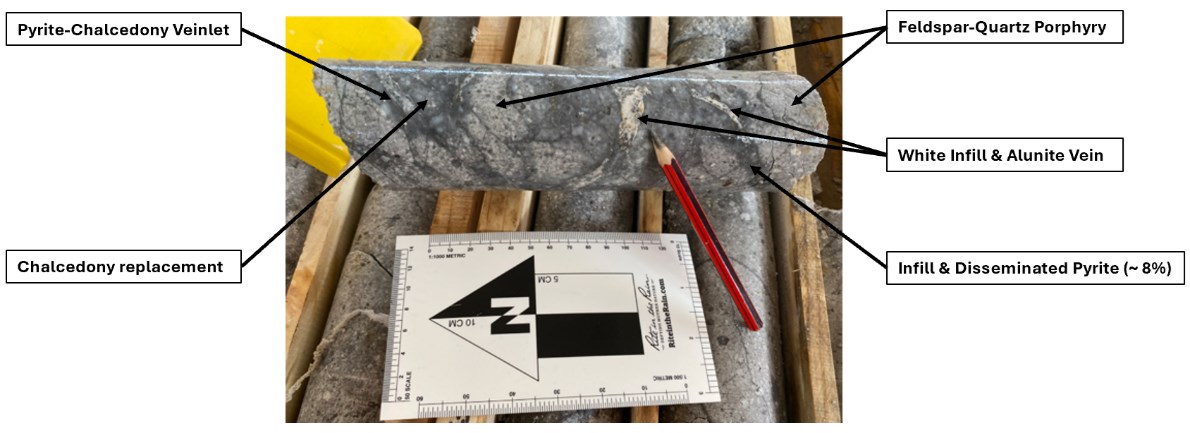
Figure 1: MON-ELV-02 drill core at 298.50 metres; showing feldspar-quartz porphyry with local chalcedony replacement, a pyrite-chalcedony veinlet, an alunite vein, and visually estimated disseminated pyrite of approximately 8%.
To view an enhanced version of this graphic, please visit:
https://images.newsfilecorp.com/files/11789/305425_3f3aa58ad44d2be3_001full.jpg
Integrated Geological, Geochemical and Geophysical Interpretation
The drilling confirms that the modelled IP chargeability response corresponds to an extensive pyrite-bearing sulphide system within the porphyry.
The main sulphide-bearing interval begins below the base of oxidation at approximately 253 metres and continues through much of the remainder of the hole. This provides geological support for Montero’s integrated targeting model, which combined geology, surface geochemistry, structural interpretation, IP chargeability and resistivity, geochemical vectoring, and three-dimensional geological modelling.
Geochemical vectoring was applied to multi-element data to identify patterns interpreted to vector toward the hydrothermal system. These results were integrated with geological mapping, historical drilling, alteration, structural, and geophysical datasets. AI and machine-learning tools assisted in evaluating relationships within these datasets and in developing the geological model used to prioritise targets for the drill programme.
Preliminary geological interpretation indicates that the porphyry intrusion was subsequently overprinted by a later high-sulphidation hydrothermal event. Quartz-alunite-pyrite alteration, local vuggy silica, and widespread sulphides show that hydrothermal fluids penetrated deeply into the intrusive host.
These observations indicate that the high-sulphidation alteration system extends below the near-surface volcanic sequence and into the underlying porphyry. It remains uncertain whether the intersected porphyry was the source of the hydrothermal fluids or whether a separate, deeper mineralising intrusion is present. If the intersected porphyry was the source, the vertical overlap of porphyry-related and high-sulphidation alteration may indicate a telescoped hydrothermal system.
Assays and Next Steps
Core logging, cutting, and sampling are continuing, and the initial sample batches have been submitted for laboratory analysis. Assay results will be used to evaluate:
- Whether gold, silver, copper, and other metals are associated with the pyrite-bearing intervals.
- The geochemical significance and distribution of the alteration and sulphide system.
- The relationship between the intersected porphyry and any deeper mineralising source.
The geological information from MON-ELV-02 will be incorporated into Montero’s three-dimensional geological model, together with the geochemical, geophysical, and structural datasets, to refine the location, orientation, and sequence of subsequent drillholes. The model will continue to be updated as geological logging, portable XRF screening and laboratory assay results become available.
Drilling of MON-ELV-03 is now underway. The design and order of later drillholes may be refined as geological observations and laboratory assay results are received.
Caution Regarding Visual Observations
The geological observations reported in this release are preliminary and are based on visual examination of drill core. Visual estimates of alteration, sulphide abundance, and mineralogy are inherently uncertain and should not be considered a substitute for laboratory assay results. The presence of pyrite, alteration or other sulphide minerals does not necessarily indicate the presence of economically significant gold, silver, or copper mineralisation. Assay results will be reported once received, reviewed, and verified by the Company.
Qualified Person
The scientific and technical information contained in this news release has been reviewed and approved by Mr. Marcial Vergara, B.Sc., an independent consulting geologist and a Qualified Person as defined by National Instrument 43-101 – Standards of Disclosure for Mineral Projects. Mr. Vergara is independent of the Company.
About Montero
Montero Mining and Exploration Ltd. is a Canadian exploration company focused on gold and copper exploration in Chile. Montero holds a 100% interest in the Avispa copper-molybdenum project in the Palaeocene Porphyry Cu-Mo Belt of northern Chile and has an option to acquire the Elvira and Potrero gold projects in the Maricunga Gold Belt. These projects are being advanced through ongoing exploration activities.
Montero is listed on the TSX Venture Exchange under the symbol MON and has 8,453,833 common shares and 735,383 stock options outstanding.
For more information, contact:
Montero Mining and Exploration Ltd.
Dr. Tony Harwood, President and Chief Executive Officer
Email: ir@monteromining.com
Tel: +1 604 428 7050
www.monteromining.com
Neither TSX Venture Exchange nor its Regulation Services Provider, as that term is defined in the policies of the TSX Venture Exchange, accepts responsibility for the adequacy or accuracy of this release.
Cautionary Statement Regarding Forward-Looking Information
This news release contains forward-looking information within the meaning of applicable Canadian securities laws. Forward-looking information includes statements regarding the interpretation of geological observations; the potential relationship between alteration, sulphide mineralisation and metal content; the timing and receipt of assay results; the refinement of the geological model; the application of geochemical vectoring, artificial intelligence and machine-learning tools to the integration and interpretation of exploration data, and the design, sequence and timing of subsequent drillholes; and the continuation of the 2026 Elvira drilling programme.
Forward-looking information is based on assumptions and estimates considered reasonable by management as of the date of this release but is subject to known and unknown risks, uncertainties and other factors that may cause actual results to differ materially from those expressed or implied. These risks include the speculative nature of mineral exploration, uncertainty in the interpretation of geological, geochemical and geophysical data, limitations and uncertainties associated with geochemical vectoring, artificial intelligence and machine-learning-assisted interpretation, the possibility that laboratory results may not confirm visual observations or current geological interpretations, operational and technical risks, permitting and regulatory risks, commodity-price fluctuations, availability of financing and other risks described in the Company’s public disclosure documents filed on SEDAR+.
Readers are cautioned not to place undue reliance on forward-looking information. Montero undertakes no obligation to update forward-looking information except as required by applicable securities laws.